Wednesday, April 28, 2010

Priesthood of the Faithful


Yesterday, Tuesday of the Fourth Week of Easter, I came upon a favorite sermon of mine in the Breviary. It's from St. Peter Chrysologus and it's based on a Scripture passage (Romans 12: 1)that we often use in the Apostleship of Prayer to provide a Scriptural basis for making a daily offering of ourselves, all the prayers, works, joys, and sufferings of our day.

The sermon begins with love. We are only able to make a loving offering of ourselves if we are deeply aware of the offering that Jesus has made for us. Thus, St. Peter Chrysologus writes:
Listen to the Lord's appeal: In me, I want you to see your own body, your members, your heart, your bones, your blood. You may fear what is divine, but why not love what is human? You may run away from me as the Lord, but why not run to me as your father? Perhaps you are filled with shame for causing my bitter passion. Do not be afraid. This cross inflicts a mortal injury, not on me, but on death. These nails no longer pain me, but only deepen your love for me. I do not cry out because of these wounds, but through them I draw you into my heart. My body was stretched on the cross as a symbol, not of how much I suffered, but of my all-embracing love. I count it no loss to shed my blood: it is the price I have paid for your ransom. Come, then, return to me and learn to know me as your father, who repays good for evil, love for injury, and boundless charity for piercing wounds.

Then St. Peter Chrysologus talks about the call of the baptized to make a return offering of themselves to the Lord. He says:
Listen now to what the Apostle [Paul] urges us to do. "I appeal to you," he says, "to present your bodies as a living sacrifice." By this exhortation of his, Paul has raised all men to priestly status.

How marvelous is the priesthood of the Christian, for he is both the victim that is offered on his own behalf, and the priest who makes the offering. He does not need to go beyond himself to seek what he is to immolate to God: with himself and in himself he brings the sacrifice he is to offer God for himself. The victim remains and the priest remains, always one and the same. Immolated, the victim still lives: the priest who immolates cannot kill. Truly it is an amazing sacrifice in which a body is offered without being slain and blood is offered without being shed.

A bit later, St. Peter Chrysologus, after making reference to a quote from Psalm 40 that also appears in Hebrews 10, he concludes with a practical exhoration on how to live the offering that all the baptized faithful are called to make:

Paul says: "I appeal to you by the mercy of God to present your bodies as a sacrifice, living and holy." The prophet said the same thing: "Sacrifice and offering you did not desire, but you have prepared a body for me." Each of us is called to be both a sacrifice to God and his priest. Do not forfeit what divine authority confers on you. Put on the garment of holiness, gird yourself with the belt of chastity. Let Christ be your helmet, let the cross on your forehead be your unfailing protection. Your breastplate should be the knowledge of God that he himself has given you. Keep burning continually the sweet-smelling incense of prayer. Take up the sword of the Spirit. Let your heart be an altar. Then, with full confidence in God, present your body for sacrifice. God desires not death, but faith; God thirsts not for blood, but for self-surrender; God is appeased not by slaughter, but by the offering of your free will.

Sunday, April 25, 2010

Ten Years Ago Today

Ten years ago today I left Holy Transfiguration Skete in Eagle Harbor Michigan. I had been there for over 7 months while on a sabbatical. I was there discerning whether or not God was calling me to a new vocation as a monk in this Ukrainian Byzantine Catholic monastery on the shores of Lake Superior. I was convinced that God was calling me out of the Jesuits and into the monastic life, but every day for about 7 months I prayed the following prayer: "Lord, I really want to be a monk here. I think You are calling me to be one. But if this is not Your will, if this is not want You want, hit me over the head!" I've always thought that it's a good idea to be direct with God.

I wasn't literally hit over the head, but after those 7 months, when I had about three weeks left in my monastic sabbatical and discernment period, God made it clear that He wanted me to remain in the Society of Jesus. In retrospect I see what a blessing all this was.

It was a blessing to experience the rich traditions of the Eastern Church. I can say that for those 7 months I learned to breathe a bit with the Eastern lung of the Church, as Pope John Paul II used to say. And, I returned to my life as a Jesuit renewed.

Ten years ago today I left the shore of Lake Superior and arrived here, on the shore of Lake Demontreville, where I worked for the next three years at the Jesuit Retreat House here. I'm In all of this I see God's hand preparing me for my current assignment as the U.S. director of the Apostleship of Prayer. I'm glad that this ministry gives me the opportunity to return to Demontreville to give retreats from time to time. This is a ministry where the words from the Peace Prayer attributed to St. Francis ring true: "It is in giving that we receive."

Saturday, April 24, 2010

Joy at Demontreville

Demontreville is the name of a lake in the St. Paul suburb of Lake Elmo. It's also the name by which most people know the Jesuit Retreat House that is located here. I gave my first retreat here in 1986 and have given over 60 retreats since then. The retreats start at 7 PM on Thursday and end at 7 PM on Sunday. They are silent retreats for men and consist of 14 half hour talks that lead the retreatants through the Spiritual Exercises of St. Ignatius.

I'm giving the retreat this weekend and, as always happens, I can tell how I'll be feeling around 4:30 PM on Saturday afternoon. Not tired. Not down. Consoled and "flying high" would be the best description. Why? On Saturday the period after the 2:30 PM talk is set aside for the celebration of the Sacrament of Reconciliation. The 71 men on retreat this weekend all had the opportunity to go to confession to one of four Jesuit confessors. I know from experience that when the time for confession is over I'll be feeling the way I'm feeling now.

As a priest, celebrating the Sacrament of Reconciliation is one of the most consoling things that I do. Through it I get to share in the joy that Jesus has in forgiving sins. I believe that this was the greatest thrill that He had when He walked this earth. He came to take away the sins of the world and it gave Him great pleasure to tell people, "Go in peace, your sins are forgiven." And so as His instrument of forgiveness today, I share in the pleasure He feels every time people bring their burden of sins, say they are sorry, and ask for pardon and absolution.

Friday, April 23, 2010

"Spring" Ministry

On Wednesday, on my way to the St. Paul, MN area, I stopped in Spring Valley, Wisconsin, a small town not too far from the Interstate on which I drove. Sacred Heart Church invited me to meet with their young adult group. After a fabulous pot-luck supper (it seems parishioners always outdo themselves in providing the best of their recipes for things like this), I met with the young people from 6 to 8. I began by telling the story of St. Ignatius and how he went from being a very worldly young man to being on fire for the Lord. It all started with a canon ball, a badly injured leg, an illness that almost killed him, and a couple books. Laid up from his wound and the subsequent surgeries, Ignatius ended up reading the only things that were available in his family's castle--a book of the life of Christ and another of the lives of the saints. His dreams gradually changed from continuing his worldly path of doing brave deeds to win the hand of a fair maiden to doing brave deeds for Jesus. I used this story of his life to talk about discerning one's way through life, one's vocation, and how important it is to pay attention to the movements of our hearts.

I then talked about how St. Ignatius, in the Spiritual Exercises, taught a method of prayer involving the use of one's imagination. We are to read a gospel passage and imagine ourselves in the scene. I always like to take that a step further and invite people to imagine what was going on it the mind and heart of Jesus and, in that way, learning to think His thoughts and feel with the deep desires of Jesus' Heart.
Before our break, I played a song entitled "Salt and Light." I've always thought of this song as an example of how the symbol of the heart is universal. While Catholics may speak of the Sacred Heart of Jesus, all Christians speak of a desire to have this Heart. This song, written and played by Evangelical Christians, speaks to me of what devotion to the Sacred Heart is all about. Here are the lyrics:

You make me want to be like You
Your holiness I will pursue
I want the heart of Jesus
Show me the meaning of Your grace
I want to give the world a taste
of the love of Jesus.

Make me salt
Make me light
Let Your holy fire ignite
Reveal Your glory in my life
I am not ashamed
To lift up Your holy name
Make me salt
Make me light

As a city on a hill
A lamp on a stand
Mold me in Your image
The work of Your hand

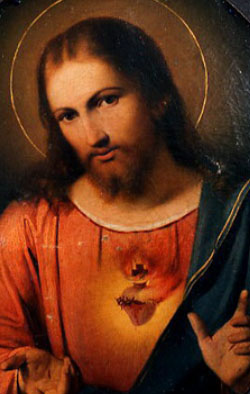
Did you notice how even some of the imagery of pictures of the Sacred Heart is in this song? "Let your holy fire ignite." That holy fire is the fire of love that burns in the Heart of Jesus. It's a flame that will set us on fire and then spread to others. That, I think, is the essence of every vocation. The vocation of every human being is to know, love, and serve God. We come to know God through Jesus who reveals the depths of God's love. As we come to know God we can't help but love God and this love shows itself in action, in how we live our lives. So no matter what vocation we are called to--marriage, consecrated life, priesthood, single--we will only truly live that vocation faithfully if we do so in response to the love of God, if we are on fire with the love of God revealed in the Sacred Heart of Jesus.

Sunday, April 18, 2010

Blessed Bernardo de Hoyos

My religious order, the Society of Jesus, has a new "blessed" today. Blessed Bernardo de Hoyos, who lived from 1711 to 1735, was beatified in Spain. This young Spanish Jesuit joins an illustrious group of young Jesuit saints: St. Stanislaus Kostka who was 17 when he died, St. John Berchmans who was 22, and St. Aloysius Gonzaga who was 24. Bl. Bernardo de Hoyos was also only 24 when he died but unlike the others he was a priest. Wait a minute! Doesn't Jesuit formation take 10 to 12 years or more from the time of entrance to ordination? Yes. So did Bl. Bernardo rush through the normal course? No, not really. Why? Because he entered the Jesuits when he was only 14 and he served less than 11 months as a priest before he died of typhus.


What makes this new Jesuit blessed especially important to the Apostleship of Prayer is that he is known as the first apostle of the Sacred Heart in Spain. In a short time, Bl. Bernardo grew in holiness through his devotion to the Sacred Heart of Jesus.


In 1732 he wrote: "I see that everything in my heart is moving towards God, drawn like iron to a magnet. It desires only God, searches only for God, and longs only for God." Within a year of this he felt a deep call to promote devotion to the Heart of Jesus. He wrote: "I felt in my spirit an extraordinary motion--strong, gentle, not abrupt or impetuous. I then placed myself before the Blessed Sacrament, offering myself to His Sacred Heart in order to cooperate as much as possible ... in propagating devotion to it."


These two quotes remind me of something that Pope John Paul II wrote in his letter announcing the Year of the Eucharist, "Mane Nobiscum Domine:" "The presence of Jesus in the tabernacle must be a kind of magnetic pole attracting an ever greater number of souls enamoured of him, ready to wait patiently to hear his voice and, as it were, to sense the beating of his heart."

Friday, April 16, 2010

"Deus Caritas Est"


I'm in Alhambra, California, at the Sacred Heart Retreat House which is run by the Carmelite Sisters of the Most Sacred Heart of Los Angeles. Though I haven't been here since December, 2008, this is my fifth retreat and it will be for about 40 women. The retreats go from Friday evening until Sunday noon.

The Sisters choose a theme for the year and for 2010 it's "Deus Caritas Est" or "God is Love." The five talks I'll be giving are: 1) God is Love, but what is Love? 2) God is Creative Love; 3) God is Redemptive Love; 4) God is Self-Sacrificing Love; 5) God is Eternal Love.

Thursday, April 15, 2010

Faith in Recovery

Last night I went to St. Mary of the Hill Parish to speak to their "Faith in Recovery" group. What is "Faith in Recovery"? They describe themselves as "A Mental Health Ministry in Faith Communities." There are a number of groups that meet throughout the Milwaukee area.

The title of my talk was "Can Suffering Have Any Value?" and the ad for the talk described it as follows:

"Suffering can be mental, physical, or due to circumstances in our lives such as job loss, broken relationships, stress and anxiety. The world approaches suffering as having no value. How can we have a balanced approach to suffering? Does our Christian faith give us an answer to this question? What about the spirituality of 'offering up' suffering?"

One of the goals of "Faith in Recovery" is to help people understand mental illness. One of their brochures has the following facts: 1) "mental illness is far more common than cancer, diabetes, heart disease or arthritis;" 2) "more hospital beds are occupied by people with serious mental illnesses than with any other disease;" 3) "it is estimated that 1 in every 4 families is affected by mental illness."

My family is among the 25% that has been affected by mental illness.

I began my presentation talking about my family and how my oldest sister Judy struggled for years with a dependency on pain-killers. Both of my parents died of cancer, my mother when she was 68 and my father when he was 75. When my sister turned 60 she developed a terrible anxiety that she too was going to suffer and then die of cancer. She was so afraid of dying of cancer that she could no longer face living. In early 2003 she went through a series of 13 electroshock treatments. On December 23, 2003, she put a plastic bag over her head and suffocated herself.

Why? That's the question that went through everyone's mind. Of course we knew the immediate answer. She couldn't kill the pain of her depression and anxiety so she killed herself. But why was this illness of hers "terminal?" Why couldn't she get better? Why didn't God answer all our prayers for her the way we wanted them answered? Why, as the title of the book goes, "Why do bad things happen to good people?"

It seems easier to deal with physical illnesses and the deaths they cause. We don't blame the person with cancer, unless he or she was a smoker. We don't tell them to just work a little harder and they'll get better. Somehow the illnesses of the mind don't receive the same sympathy. We tend to blame the person who is depressed and expect that if they just tried harder they could get better. We don't get angry at the person with cancer, but we easily slip into anger at the person with a mental illness. We don't tell the cancer patient to get over their symptoms and we feel sorry for them when they experience bad side effects from their medications and treatment. We don't have the same sympathy for the mentally ill; we expect them to use will-power to get over their symptoms and we try to ignore the side effects of their medication.

I can't help thinking that Fr. Gerard Manley Hopkins, a Jesuit poet of the Nineteenth Century, struggled with depression and/or spiritual desolation, perhaps "the dark night of the soul." Some of his verses certainly describe what people who struggle with an illness of the mind feel.

In one sonnet, he writes:

"O the mind, mind has mountains; cliffs of fall
Frightful, sheer, no-man-fathomed. Hold them cheap
May who ne'er hung there.

Those who struggle with mental illness know the mountains of the mind and how dangerous they can be. At times they hang, as it were, by a thread over a precipice. Those of us who have not struggled in this way have a hard time understanding.

Another among what are known as "The Terrible Sonnets," captures the experience of darkness and despair and the silence of God.

"I wake and feel the fell of dark, not day,
What hours, O what black hours we have spent

This night! what sights you, heart, saw; ways you went!
And more must yet, in longer light's delay.
With witness I speak this. But where I say
Hours I mean years, mean life. And my lament
Is cries countless, cries like dead letters sent
To dearest him that lives alas! away.

How does the poet deal with this? How does he try to deal with himself?

"My own heart let me more have pity on; let
Me live to my sad self hereafter kind,
Charitable; not live this tormented mind
With this tormented mind tormenting yet.

Illness, pain, suffering--these lead us to ask "Why?" But there is no satisfactory answer. It is a mystery in the truest sense of that word. Not something we will understand this side of eternity. And suffering is inevitable in everyone's life, but we have a choice in how we deal with it. I offered three suggestions that I have found helpful.

First, the Serenity Prayer: "God, grant me the serenity to accept the things I cannot change, the courage to change the things I can, and the wisdom to know the difference." Basically this is a prayer of acceptance. It leads us to accept suffering when it comes and cannot be avoided instead of reacting with resentment, blame, self-pity, or denial. Acceptance doesn't take away the pain, but it can lead to inner peace.

Second, the 12 Step spirituality of recovery programs. The 12 Steps of AA are not just for alcoholics, drug or sex addicts, over-eaters, or the spouses, children, and friends of them. They're for everyone. Bill W., the author of the 12 Steps and founder of Alcoholics Anonymous, used the 12 Steps to deal with a compulsion to drink that was out of control. After some time of sobriety he ended up facing a new challenge--depression. He came to realize that he could use the same program that got him sober and helped him maintain sobriety to deal with depression. He wrote an article about this called "The Next Frontier: Emotional Sobriety."

Third, the Apostleship of Prayer. At the beginning, in 1844, the Jesuit seminarians learned to make a prayerful offering of their frustrations and sufferings. In this way they found meaning and purpose in them. Years later Dr. Victor Frankl, a Jewish psychiatrist who survived Auschwitz, wrote a book about his experience entitled "Man's Search for Meaning." He concluded that under the terrible conditions of a concentration camp, people didn't survive simply to survive. Those who survived generally had a purpose that transcended mere physical survival. They were committed to surviving for a greater purpose that transcended themselves--a family, a research project, a work of art, God.

Ultimately the secret of the Apostleship of Prayer is that the pains and sufferings we meet in life can have value. It's the value of prayer which, when joined to sacrifice, becomes most like the prayer of Jesus. To offer up the pains and sufferings that come our way helps us find light in darkness. It helps us to trust that even when all we have to offer is our pain, we are doing a great work because it's joined to the work that Jesus accomplished on the Cross when He saved the world.