Showing posts with label St. Ignatius. Show all posts

Tuesday, October 25, 2016

Prayer Pierces the Heavens

     
The readings for the Thirtieth Sunday in Ordinary Time Cycle C continue the theme of prayer.  In the first reading (Sirach 35: 12-14, 16-18) we read: “The one who serves God willingly is heard; his petition reaches the heavens. The prayer of the lowly pierces the clouds; it does not rest till it reaches its goal, nor will it withdraw till the Most High responds….”

From time to time I’ve been asked, “What’s the point of praying? If God know everything and even knows what is in our hearts before we put words to our concerns and desires, what’s the point of praying? 

Our world is obsessed with action.  We tend to think of prayer as a last resort.  When practical action appears to be impossible we say, “Well, I guess I’ll just pray.”  “Just!?”  Is prayer a last resort rather than the first?

There is a line attributed to both St. Augustine and to St. Ignatius Loyola.  While the former may have written it, the latter, I’m told by the Jesuit historian Fr. John Padberg, did not.  In fact, St. Ignatius probably reversed the order of the saying.

The saying goes: “Pray as though everything depends on God and work as though everything depends on you.” 

It is good to recognize when we pray that the Holy Spirit is the one who prays within us (see Romans 8: 26-27).  And it is good to work hard.  But the reverse of the saying—“Pray as though everything depended on you and work as though everything depended on God”—makes more sense. 

In other words, we should put time, effort, and energy into our prayer, praying as though it’s up to us but knowing that grace is always a gift.  And we should work in such a way that we leave the results to God rather than thinking that our sheer effort will accomplish things. 

This is where the Gospel (Luke: 18: 9-14) comes in.  The Pharisee congratulates himself on his works and goes away unjustified, while the tax collector prays with humility and is said to go away justified.  The key, as we’ve heard in previous Sundays’ Gospels, is humility.

The word comes from “humus”—dust or earth.  Humility recognizes that I am not God, not in control, and cannot overcome every obstacle by my own effort and hard work. 

Humble or lowly prayer surrenders to God who created us to share in the love of the Trinity and the communion of all saints.  When we pray fervently and persistently, our prayer pierces the heavens and opens a channel for God’s grace and mercy to enter the world.  Like parents who show respect and love to their children, inviting them to work alongside of them though they do not need their help in assembling a toy or cooking a meal, God respects and loves us by including us in the work of caring for creation and the human family. 


Prayer is not so much changing God’s mind as opening ourselves up to Trinitarian Love and allowing God to transform us and work through us to transform the world.  

Tuesday, January 28, 2014

The Angelic Doctor

Today is the feast of the great Dominican theologian St. Thomas Aquinas. He lived a relatively short time, from 1225 to 1274, but wrote extensively and is considered by many to be the greatest theologian of all time. Though he died on March 7 he is honored today because on this day in 1368 his relics were transferred from what is now Italy, where he died, to Toulouse, France.

Almost 300 years later, the founder of the Jesuits, St. Ignatius Loyola, showed his appreciation for the writings of St. Thomas Aquinas by making him required reading.  The Constitutions of the Society of Jesus, in a section on the universities which the Jesuits would run for both the formation of its own members and for the education of lay people, state: "In theology there should be lectures on the Old and New Testaments and on the scholastic doctrine of St. Thomas" (#464). 

A book of prayers for Jesuits that Father John Hardon, S.J., edited and which was published by Loyola Press in 1963 contains seven entries for St. Thomas Aquinas.  Here is one of them:

For the Honor of Your Name

Merciful God, grant that I may eagerly desire, carefully search out, truthfully acknowledge, and ever perfectly fulfill all things which are pleasing to You. Order all my life for the glory and honor of Your name alone. Enlighten me to know what You want of me, and help me do it properly and with profit to my salvation. Grant that I may not fail or swerve either in prosperity or adversity; that I be not lifted up by the one, nor cast down by the other. Let me enjoy only what leads to You, and grieve only for what leads away from You; let me neither seek to please, nor fear to displease, any but You alone. May all transitory things grow vile in my eyes, O Lord, and may all that is Yours be dear to me for Your sake, and You, my God, dear above them all. May all joy be irksome to me that is without You, may all labor and toil delight me which is for You, and rest be weariness which is not in You. Amen.

Wednesday, November 6, 2013

All Heroes

Last Friday, the Solemnity of All Saints, I presided and preached at the all-school Mass at St. Ignatius Prep in Chicago. 

Our first reading from the Book of Revelation (7:2-4, 9-14) gives us a picture of the saints in heavenly glory. These are the heroes and heroines of our faith. They had the courage to stand up for what is right even when their lives were threatened. The image may make them seem distant from us, but they are in reality very close.

I like another image of the saints that can be found in Hebrews 12: 1-2: "Since we are surrounded by so great a cloud of witnesses, let us rid ourselves of every burden and sin that clings to us and persevere in running the race that lies before us while keeping our eyes fixed on Jesus, the leader and perfecter of faith." 

Some years ago I lived at the Jesuit Novitiate on Summit Avenue in St. Paul, Minnesota. Every fall the Twin Cities Marathon would race by our house. Actually, the first runners "raced by" but as the hours passed, the stragglers--some barely jogging, many just walking--came chugging along.  People lined up along the street to watch would cheer them on and hand them cups of water and Gatorade.

That's the image we see in Hebrews. We are in the race of life and we are surrounded by the saints who offer us encouragement, who pray for us, who intercede for us. We may be physically separated from them and from other deceased people but we are intimately united to them in a deep, spiritual bond. We are all members of the Body of Christ. Some parts of the Body have died but that doesn't mean they have gone out of existence. Rather, they are now with the Lord, the Head of the Body. You could say that we have friends in high places.

Last Wednesday Pope Francis said: "In this communion--communion means 'common-union'--we are a great family, all of us, where all the components help and support each other. ... All the baptized down here on earth ... and all the blessed who are already in paradise make up one great family."

We are one family because we are all children of God. We are children not just in name but in reality as our second reading (1 John 3:1-3) tells us: "See what love the Father has bestowed on us that we may be called children of God. Yet so we are."  As family we can ask for each other's help. Pope Francis said: "Our faith is in need of the support of others, especially in difficult moments. If we are united, faith becomes strong. Which one of us--everyone, everyone--has not felt insecurities, losses and even doubts in the journey of faith? All of us have experienced this, even myself: it is part of the path of faith, it is part of our life."

So we need to support one another. We need to ask for help from one another and from the saints. But to ask for help, Pope Francis said, requires two things--humility and courage. "It is important to find the courage and the humility to open oneself to others, to ask for help, to ask for a hand."  It takes humility to admit that one is weak and in need of help. It takes courage to ask for that help.

We see both of these virtues--humility and courage--in the Beatitudes which are the basis of holiness, the basis of friendship with God and with one another.

Jesus said "Blessed are the poor in spirit" but the world says "Blessed are the proud, the self-sufficient, the independent who don't have to rely on others."

Jesus said "Blessed are they who mourn," who are able to share in the sufferings and sorrows of others. But the world says "Blessed are those who are untouched by others' sufferings, who are unfazed by sorrow, who are cold and indifferent."

Jesus said "Blessed are the meek" but the world says "Blessed are those who try to get to the top so that they can be above everyone else."

Jesus said "Blessed are they who hunger and thirst for righteousness," who support their friends in doing what is right.  The world says "Blessed are those who follow the trends of a culture of death."

Jesus said "Blessed are the merciful," those who forgive one another. The world says "Blessed are those who get even, who hold grudges and resentments against one another so that they won't be vulnerable and get hurt again."

Jesus said "Blessed are the clean of heart," the pure of heart who see one another as beloved children of God. The world says "Blessed are those who see others as objects to be used for pleasure or in order to get ahead."

Jesus said "Blessed are the peacemakers" but the world says "Blessed are those who argue and create conflict, who gossip about others and add to the contentious environment in which we live."

Jesus said "Blessed are they who are persecuted." And you will be if you live according to these Beatitudes. The world will oppose you.

The Beatitudes are difficult to follow, in fact, impossible. On your own, that is. But they are what make heroes, saints.

At St. Ignatius Prep you have a great patron who can help you--St. Ignatius, the founder of the Jesuits. Next week Mr. Santiago Rodriguez, S.J., the youth and young adult director of the Apostleship of Prayer will be here to show you what you can learn from St. Ignatius. You will have an opportunity to participate in sessions that will address the purpose and meaning of life, discernment and tools for making good decisions, how the imagination can be used in prayer, and the "magis" or "more."

This was at the heart of St. Ignatius. It wasn't enough to do a few things for God. He always wanted to do more. It wasn't enough to give God great glory. He wanted to give God greater glory.

Later this month you will be hearing a lot about President Kennedy.  It's the 50th anniversary of his assassination. In the speech he gave when he was inaugurated, he said "Ask not what your country can do for you; ask what you can do for your country."  These words inspired a generation to volunteer to help others through the Peace Corps and VISTA. They inspired many to work for civil rights and for peace. 

Today, as we honor the saints, we can hear words similar to those of President Kennedy and ask what we can do to live heroic lives? Ask not what others can do for you; ask what you can do for others. Ask not what your Church can do for you; ask what you can do for your Church.

Monday, September 2, 2013

Some Labor Day Thoughts

The last of St. Ignatius' Spiritual Exercises is called "The Contemplation to Attain the Love of God." One of his "points" is:

"This is to consider how God works and labors for me in all creatures upon the face of the earth, that is, He conducts Himself as one who labors. Thus, in the heavens, in the elements, the plants, the fruits, the cattle, etc. He gives being, conserves them, confers life and sensation, etc. Then I will reflect on myself."

Figuratively speaking, according to Genesis, God worked for six days in creating the world and then rested. Humanity is made in God's image and likeness and so we are made to work and labor with God for the good of creation.  We are stewards of God's creation.  God cares for creation through us. 

The Gospel at Mass today (Luke 4: 16-30) is what many have called Jesus' "Inaugural Address" in which he announces his plan of action as he begins his active ministry after his "hidden life" of work at home and with his foster father Joseph.  But the people who hear him do not have the eyes of faith and so they reject him and his words. They cannot see how God will accomplish the great works promised by the prophet Isaiah through Jesus. 

We are called to have eyes of faith. One of the goals of the Apostleship of Prayer and the Daily Offering is to offer our daily work to God. Such an offering will, with time, help us to see our work with eyes of faith. By offering our work each day and then reflecting upon the daily work that has been offered, our eyes become more sensitive to seeing God at work through us.  In that way, more and more, our daily work will play a hidden or sometimes more explicit role in the work of preparing creation to receive Jesus in his second coming.

The first Mass reading today (1 Thessalonians 4: 13-18) speaks of that second coming when Jesus will raise all people to new life in the Kingdom of God.  Our lives are meant to prepare the world for that day.  Our work plays a role in that preparation. 

In the Our Father we pray "Thy Kingdom come, Thy will be done."  When we follow God's will by making an offering of our day with its work, we are allowing the Kingdom of God to break into our lives and the lives of those around us.  Little by little Christ reigns in us and over us. As he reigns, God's work is accomplished in us and through us.  May we have the eyes of faith to see and believe this!

Wednesday, February 8, 2012

Desolation and Discernment

Last Sunday I was at Bellarmine Jesuit Retreat House in Barrington, IL and I had the opportunity to preach. The first reading from the seventh chapter of Job made me think about St. Ignatius' Rules for the Discernment of Spirits and his advice about what to do during a time of desolation.

Job says: "Is not man's life on earth a drudgery? ... I have been assigned months of misery, and troubled nights are allotted to me. If in bed I say, 'When shall I arise?' then the night drags on; I am filled with restlessness until the dawn. My days are swifter than a weaver's shuttle; they come to an end without hope. Remember that my life is like the wind; I shall not see happiness again."

Now here's how St. Ignatius describes spiritual desolation: "I call desolation ... darkness of soul, turmoil of spirit, inclination to what is low and earthly, restlessness rising from many disturbances and temptations which lead to want of faith, want of hope, want of love. The soul is wholly slothful, tepid, sad, and separated, as it were, from its Creator and Lord." Doesn't that sound like what Job was going through?

Then St. Ignatius gives very practical advice on how to deal with desolation.

First, he says that "in time of desolation we should never make any change, but remain firm and constant in the resolution and decision which guided us the day before the desolation, or in the decision we adhered in the preceding consolation." When we experience desolation our temptation is to change course or to do everything we can to escape from it. The problem is that it is the evil spirit which is behind the desolation and not the Holy Spirit. Thus, as Fr. Thomas Green, S.J., once said, if you want the evil spirit as your spiritual director then listen to the thoughts that arise during desolation.

The second piece of advice is a bit of a caveat. Though we are not to make a significant change in our decisions, we can make some changes in our prayer. Thus, Ignatius writes: "Though in desolation we must never change our former resolutions, it will be very advantageous to intensify our activity against the desolation. We can insist more upon prayer, upon meditation, and on much examination of ourselves." This is because desolation tempts us to give up on prayer. We fight the temptation by going in its opposite direction.

Then St. Ignatius says that desolation is an opportunity to grow in humility. During times of consolation a person can become puffed up, thinking that one is really close to God and quite the holy person. Desolation reminds us that without God's grace, we are nothing. Ignatius writes: "When one is in desolation, he should be mindful that God has left him to his natural powers to resist the different agitations and temptations of the enemy in order to try him. He can resist with the help of God, which always remains, though he may not clearly perceive it. For though God has taken from him the abundance of fervor and overflowing love and the intensity of His favors, nevertheless, he has sufficient grace for eternal salvation."

Trials and temptations are opportunities to grow in particular virtues which are like spiritual muscles that develop through exercise. In desolation one is tempted to despair and give up hope; the opportunity is to exercise hope by making acts of hope and faith. Desolation is also an opportunity to exercise patience. St. Ignatius writes; "When one is in desolation, he should strive to persevere in patience. This reacts against the vexations that have overtaken him."

Finally, St. Ignatius gives advice that is also a slogan in Alcoholics Anonymous and other 12 Step Recovery Programs: This too shall pass. As he puts it: "Let him consider, too, that consolation will soon return, and in the meantime, he must diligently use the means" that are given above--prayer, meditation, and self-examination.

Desolation is never any fun and does not come from Holy Spirit, but God allows it and can even use it to help us grow in prayer and the virtues.

Thursday, December 15, 2011

More Magis Reflections

Here are the last three of the daily reflections that I wrote for the Magis Center for Catholic Spirituality.

Thursday, December 15, 2011

We are made for union with God. We are made for a spousal relationship with God. In the Song of Songs and the Prophets of the Old Testament, we find this truth in vivid terms like the following verse from Isaiah 54: 5: “For he who has become your husband is your Maker; his name is the Lord of hosts….”

This goal of human existence begins to find its realization in the Eucharist. It is there that the union between each individual and the Lord is most closely attained on this side of eternity. There the Church is formed. St. Paul, writing to the Ephesians, taught about marriage by quoting from the book of Genesis: “For this reason a man shall leave father and mother and be joined to his wife, and the two shall become one flesh.” Then Paul goes on to say, “This is a great mystery, but I speak in reference to Christ and the church” (5: 31-32). Marriage is sacred because it reveals something of the intimate union that Christ has with the Church and with each of her members. It is a union that transforms. As Pope Benedict said in his final homily at World Youth Day 2005: “The Body and Blood of Christ are given to us so that we ourselves will be transformed in our turn. We are to become the Body of Christ, his own Flesh and Blood.” The two—Christ and each one who receives him in the Eucharist—become one flesh.

This is another way of viewing the “First Principle and Foundation” in the Spiritual Exercises and it is what answers a question that arises from today’s Gospel (Luke 7: 24-30): how can it be that “the least in the Kingdom of God is greater than” John the Baptist? John, the great Forerunner and Martyr-Witness to the Messiah, did not have the privilege of the union that we have every time we receive the Body and Blood of Christ. Can we ever be sufficiently grateful for this privilege?

Friday, December 16, 2011

Jesus called John the Baptist “a burning and shining lamp” (John 5:35). The Lord calls you to be like John, to be a lamp that “shine before others, that they may see your good deeds and glorify your heavenly Father” (Matthew 5: 16).

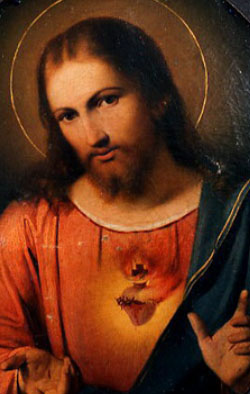
You are called to burn with the love of the Sacred Heart which Jesus revealed to St. Margaret Mary, saying: “My divine Heart is so passionately fond of the human race, and of you in particular, that it cannot keep back the pent-up flames of its burning charity any longer. They must burst out through you.” To be on fire with the burning love of God requires you to draw near to the Heart of Jesus. It means being a “burning” lamp that is fed by the oil of the Holy Spirit who prays with you and within you. It means especially becoming one with the Sacred Heart that is given to you in the Eucharist.

You are also called to shine. Jesus called himself “the Light of the world” (John 8:12) and as he unites himself to you he calls you to be light as well (Matthew 5: 14). The light of a “shining lamp” is very humble. You don’t light a lamp and then stare at it. A lamp is lit not to draw attention to itself but to help people find their way. So it is with you. You are to be the light of the world in order to show people the way to the final destination for which God created the human race—heaven.

According to St. Ignatius, the goal of his Spiritual Exercises, and indeed the goal of all prayer, is to help us seek and find “the will of God in the disposition of our life for the salvation of our soul” (#1). It is God’s will that you be one with him forever in the Kingdom of Heaven. Through prayer you are united one day at time with this loving will of God that fills you with warmth and light, that makes you “a burning and shining lamp” that will guide others to the Lord just as St. John the Baptist did.

Saturday, December 17, 2011

We begin today the final days of preparation for Christmas with the “O Antiphons” (found in antiphon for Mary’s Magnificat at Vespers and in the Alleluia verse at Mass). We also have the Genealogy of Jesus according the Matthew. Besides giving us the human origins of the Messiah, it reminds us of the Providence of God which, in St. Paul’s words, can “make all things work for good for those who love God” (Romans 8: 28).

The Genealogy does not paint a pretty picture. It includes a number of kings who led Israel away from God to the worship of idols. It also includes the names of four women, an unusual addition in the genealogies of the time. The childless and widowed Tamar disguised herself as a prostitute in order to have intercourse with her father-in-law Judah. Rahab was a prostitute. Ruth was a foreigner. And Bathesheba was the unfortunate recipient of King David’s attention, leading to his committing adultery with her and orchestrating her husband’s death.

The Genealogy or Family Tree of Jesus included sinners in need of mercy and healing. This shouldn’t be surprising since it was to save sinners that Jesus took flesh and came into the world. Or, as St. Ignatius puts it in his contemplation on the incarnation, the “Three Divine Persons look down upon the whole expanse or circuit of all the earth, filled with human beings. Since They see that all are going down to hell, They decree in Their eternity that the Second Person should become man to save the human race” (#102).

In this final of Advent, imagine the Blessed Trinity looking out over the world. Out of love for lost humanity, God sent the Son to live and die and rise for your salvation. He wants you to be filled with “an intimate knowledge” of His love so that you may “love Him more and follow Him more closely” (#105) and in this way to continue the work of salvation.

Tuesday, December 13, 2011

Magis Reflections

Here are some more reflections, for today and tomorrow, that I did for the Magis Center for Catholic Spirituality. While I was able to put in a word for St. Lucy today, I regret that I didn't say anything about one of my favorite Carmelite saints, St. John of the Cross, whom we celebrate tomorrow.

Tuesday, December 13, 2011

Several years ago a radio station took a survey and asked listeners to call and answer the question: “Is love a feeling or a decision?” Almost 90% called to say that love is a feeling.

St. Ignatius would say that love is more than a feeling and it’s more than a decision. The second son in today’s Gospel (Matthew 21: 28-32) decided to work in his father’s vineyard and said he would do so, but didn’t actually go. The first son decided not to go and said so but in the end changed his mind and went. Who fulfilled the will of the father? Clearly the first son. Who, can it be said, loved the father more? While both would perhaps declare their love for the father it was the first son who proved that love by his deeds. As St. Ignatius wrote in the Spiritual Exercises, at the beginning of the “Contemplation to Attain the Love of God”: “love ought to manifest itself in deeds rather than in words.”

This is the way God, whom St. John wrote is Love (see 1 John 4: 8 and 16), operates. God, as St. Paul wrote, “proves his love for us in that while we were still sinners Christ died for us” (Romans 5: 8). The Son of God took flesh and offered his flesh on the cross for the salvation of the world. The Light of the world entered into its darkness and calls each of us to be one with him, sharing in the light and being light for the world (see Matthew 5: 14-16).

Today we honor a virgin-martyr of the early Church, St. Lucy, whose very name means Light. Like Lucy we must be lights for our world of darkness, but we are only able to be such in so far as we grow in union with the Light, in so far as we love God and our neighbor in deed and not just in words or feelings.

Wednesday, December 14, 2011

The disciples of John the Baptist approached Jesus and asked him, “Are you the one who is to come, or should we look for another?” In other words, “Who are you?” Jesus answered by telling them to report what they had “seen and heard,” what they had experienced. What about you? How do you answer the question, “Who is Jesus?” Do you rely on what others have said or taught, or can you report what you have “seen and heard” of Jesus in your own experience? This is the goal of Ignatian contemplation: to not just think about Jesus as you read the Gospel stories but to meet and experience him there. Imagining the Gospel scenes and putting yourself into the scene, conversing with the various figures, can help you to know the Lord in a deeper way so that you can answer the question “Who is Jesus?” from personal experience rather than from what others have said.

Pope Benedict made a similar distinction in his Wednesday Audience of October 8, 2008. He said:

Only with the heart does one truly know a person. Indeed, the Pharisees and the Sadducees were externally acquainted with Jesus, they learned his teaching and knew many details about him but they did not know him in his truth. … On the other hand, the Twelve, thanks to the friendship that calls the heart into question, have at least understood in substance and begun to discover who Jesus is. This different manner of knowing still exists today: there are learned people who know many details about Jesus and simple people who have no knowledge of these details but have known him in his truth: "Heart speaks to heart".

Sunday, December 11, 2011

Old St. Joseph's Church

I've been having a busy Advent. On the First Sunday of Advent I was still in Rome for the meeting of the International Advisory Council of the Apostleship of Prayer. Last weekend I was in Alhambra, California at Sacred Heart Retreat House for their annual Advent Retreat. And this weekend I'm preaching at all the Masses at Old St. Joseph's Church in Philadelphia. I'm here to lead a parish mission which begins this evening.


Today, at 5 P.M., we'll celebrate Vespers for this Gaudete Sunday. My talk is entitled "Heart Calls to Heart: Deepening Our Personal Relationship with Jesus." Tomorrow evening at 7:15, in the context of an Advent Reconciliation Service, I'll talk about "Meeting the Merciful Heart of Jesus." On Tuesday we will close the mission with Exposition and Benediction and a talk entitled "Take, Lord, Receive: Living a Eucharistic Life."

Old St. Joseph's Church is the Jesuit church in Philadelphia and its oldest Catholic church. It was built in an alleyway at a time in U.S. history when most of the original 13 colonies did not allow Catholics to practice their faith.


Periodically the Magis Center for Catholic Spirituality asks me to write a daily reflection for their subscribers. Below I've included my brief reflections for today and tomorrow.


Sunday, December 11, 2011

“Pray without ceasing.” Thus wrote St. Paul and over the centuries people have tried to figure out how to do this. For some, primarily in the Eastern Churches, it has meant praying “The Jesus Prayer”: “Lord, Jesus Christ, Son of God, have mercy on me, a sinner.” Or simply, “Lord Jesus Christ, have mercy on me,” uniting each phrase with one’s breath.

The Apostleship of Prayer encourages another approach—the Morning Offering. Here’s how the great Jesuit Fr. Walter Ciszek, whose cause for beatification has been opened, described this prayer in the account of his imprisonment in the Soviet Gulag and exile, He Leadeth Me:

In my opinion the Morning Offering is still one of the best practices of prayer—no matter how old-fashioned some may think it. For in it, at the beginning of each day, we accept from God and offer back to him all the prayers, works, and sufferings of the day, and so serve to remind ourselves once again of his providence and his kingdom. If we could only remember to spend the day in his presence, in doing his will, what a difference it would make in our own lives and the lives of those around us! We cannot pray always, in the sense of those contemplatives who have dedicated their whole lives to prayer and penance. Nor can we go around abstracted all day, thinking only of God and ignoring our duties to those around us, to family and friends and to those for whom we are responsible. But we can pray always by making each action and work and suffering of the day a prayer insofar as it has been offered and promised to God.

The Morning Offering, combined with an Examen or Evening Review of the day we have offered, can help us to seek and find God in all things, in all the people and events of our daily lives. In this way we better able to “pray without ceasing.”

Monday, December 12, 2011

Viva la Virgen de Guadalupe! Viva! Today we honor our Blessed Mother under her title “Our Lady of Guadalupe” and we remember how in December, 1531 she appeared to a humble Indian, St. Juan Diego, and gave him a miraculous image of herself as proof for the bishop of her appearance. The image, on material that should have disintegrated long ago, can be seen today in Mexico City.

When she appeared to Juan, she affectionately called him “Juanito” or “Johnny,” and said:

Know for certain, smallest of my children, that I am the perfect and perpetual Virgin Mary, Mother of the True God through whom everything lives, the Lord of all things near and far, the Master of heaven and earth. I am your merciful Mother, the merciful mother of all of you who live united in this land, and of all humanity, of all those who love me. Hear and let it penetrate your heart, my dear little one. Let nothing discourage you, nothing depress you. Let nothing alter your heart, or your face. Am I not here who am your mother? Are you not under my shadow and protection? Am I not your fountain of life? Are you not in the folds of my mantle? In the crossing of my arms? Is there anything else that you need? Do not fear any illness or vexation, anxiety or pain.

St. Ignatius had a deep love for the Blessed Virgin Mary and he often turned to her when he needed special help. He recommends the same to us during key meditations in the Spiritual Exercises. As Jesus could not refuse his mother’s request at Cana (see John 2: 1-11), so, St. Ignatius was convinced, that if we go to Jesus with his mother and then with Jesus and Mary to the Father, we will receive what we need.

Monday, August 22, 2011

Magis and World Youth Day

I've been in Milwaukee all week, holding down the fort at the Apostleship of Prayer national office. Fr. Phil Hurley has been in Spain. I've tried to follow the events of Magis and World Youth Day and want to share some of those experiences here.


What is "Magis?" It's Latin for "More" and it's a theme that appears in the life of St. Ignatius and the order he founded, the Jesuits. For St. Ignatius, it wasn't enough to live and work for God's glory. He wanted to give his life for God's greater glory. That's the "more," the "magis."

Magis was a pre-World Youth Day program that brought together, from around the world, people associated with Jesuit schools and apostolates. They broke into small groups and engaged in service projects and pilgrimages. Some went to the birthplace of St. Ignatius where he also experienced his conversion and some others went on the Camino, the road to Santiago Compostela, to the shrine of St. James the Apostle to which pilgrims have journeyed for centuries.


Since the Magis program did not accept pilgrims under the age of 18, some Jesuit schools, like Jesuit High in New Orleans, made their own pre-WYD pilgrimage to the Ignatian sites. I was inspired by a blog entry of one of their chaperones, a Jesuit scholastic or seminarian, Nathan O'Halloran, which can be found here. There are other photos and descriptions of their pilgrimage here. I commented on Nathan's blog that I found these to be a "virtual pilgrimage" for one who stayed home. Through these two links I not only saw the sights but also experienced some of the grace of the pilgrimage.

Fr. Phil Hurley and the Apostleship of Prayer were present at the largest English-speaking venue at WYD in Madrid, the Love and Life site. He was part of a panel that talked about prayer and he sent us the link to the video that Salt + Light TV from Canada made of the presentations. His own contribution can be found on the video from 1:36:40 to 1:47:34 at the following site:


http://www.livestream.com/wydcentral/video?clipId=pla_e759f459-dc2f-4e1d-b640-4b72744e4f6f

I commented on our Facebook page that I wouldn't be surprised if we start getting requests for Fr. Phil to sing after he displayed his musical talent in the video.

Though a rain storm spoiled some of the Saturday night vigil, I'll be blogging more about that another time....

Friday, April 22, 2011

Good Friday

I will be leading my Jesuit community's "Celebration of the Lord's Passion" this afternoon. I can't help approaching this time of prayer from the perspective that St. Ignatius gives in his Spiritual Exercises. He invites us to not simply read the Gospel stories, to not just observe the scenes from the outside, but to enter into the story, to put ourselves in the Gospel scenes. We do that during the reading of the Passion when we prayerfully take on the roles of various characters and the crowd. But St. Ignatius would have us go even deeper. He would have us enter into the interior of Jesus and to experience what he thought and felt. We find this in the "Third Prelude" to the various Exercises in what is known as the "Third Week":

This is to ask for what I desire. In the Passion it is proper to ask for sorrow with Christ in sorrow, anguish with Christ in anguish, tears and deep grief because of the great affliction Christ endures for me.

With these words, St. Ignatius invites us to enter into the Heart of Jesus. We are to share his "sorrow" and his "anguish." We cannot experience his physical sufferings, but we can share his interior sufferings. We may even try to imagine what Jesus thought and felt as he looked out at the world from the cross. Imagine yourself there, one of the curious bystanders looking on to see this spectacle of blood and death. You are there in the crowd, but in a flash Jesus looks right at you. He catches your eye. You want to look away, but you are drawn to stay with the eyes that have caught your eyes. What do you see in those eyes?

Looking into the eyes of Jesus on the cross we see not condemnation but love, a deep personal love. Notice how the "Third Prelude" invites us to not only enter into the interior sufferings of Jesus but also to realize that he endured all this "for me." His suffering and death are very personal. If I were the only human person who ever lived, he would have done this "for me." He loves me with an infinite love. Our own experience of love is limited, for we humans cannot love with an infinite love. A deep and intimate love for one person naturally tends to be exclusive. Such love means there is less love for another, though parents will say that they love each of their children with an equal and total love.

St. Francis de Sales uses a striking image of God's infinite love. He says that the sun's light and warmth come to one flower and this doesn't mean that there is less light and warmth for the other flowers. If this is true for the sun, how much more true is it for the Creator of the sun and his love? Yet even this physical analogy of the sun pales in comparison to God's love. Clouds block the sun which sets at night, leaving the flowers in darkness. Not so God's love which is always there. Even sin, which separates us from God, doesn't extinguish the love of the Son on the cross. Remember, as St. Paul pointed out so clearly, "God proves his love for us in that while we were still sinners Christ died for us" (Romans 5: 8).

The love of Jesus is personal but it is also universal. The Catechsim of the Catholic Church, quoting the Council of Quiercy in the year 853, states: "There is not, never has been, and never will be a single human being for whom Christ did not suffer" (#605). It is this universal love that leads us, in the "Celebration of the Lord's Passion," to offer a long set of "General Intercessions." In them we pray for the entire Church, for the pope, for the clergy and laity of the Church, for those preparing for baptism, for the unity of Christians, for the Jewish people, for those who do not believe in Christ, for those who do not believe in God, for all those in public office, and for all those in special need.

Perhaps, as we offer these long prayers, we could do so with the love of Jesus. Looking into his eyes on the cross, we see his love for us--a personal and individual love. We also see that this deep love is for everyone. As we pray for the various groups, let us look upon them with the eyes of Jesus. Let us see them as Jesus saw them from the cross. Let us pray for them with the love of Jesus in our hearts: a love that desires everyone to know his love, accept it, and be saved; a love that proves itself by dying even for those who have rejected it.

Saturday, December 25, 2010

St. Ignatius' First Mass

On Christmas Day, 472 years ago, St. Ignatius Loyola celebrated his first Mass. He had been ordained 18 months earlier, on the feast of the Birth of St. John the Baptist, June 24, 1537. He had been hoping to celebrate his first Mass in the land where the Son of God took flesh and was born, but because of the threat of Turkish pirates no ships would sail from Italy to the Holy Land. He settled for the next best place--the Basilica of St. Mary Major in Rome. This church, one of the major basilicas of Rome, was the first Roman church built in honor of the Mother of God. In it was a chapel dedicated to the Nativity and relics from the manger where Jesus was laid after His birth. If he couldn't celebrate his first Mass in Bethlehem, he would celebrate it there, on Christmas Day.

Christmas is a Eucharistic feast. The Second Person of the Blessed Trinity took flesh and was born in order to give His flesh for the life of the world. The Bread of Life was born in a town named Bethlehem, a name which means "House of Bread." His mother placed Him, who would one day say, "my flesh is true food and my blood is true drink" (John 6: 55), in a manger, a feeding trough.

After (and probably during) that first Mass and throughout his ordained life, St. Ignatius cried during Mass. Such tears are a sign of spiritual consolation which St. Ignatius describes in his "Spiritual Exercises" as "when some interior motion is caused within the soul through which it comes to be inflamed with love of its Creator and Lord.... Similarly, this consolation is experienced when the soul sheds tears which move it to love for its Lord..." (#316). His early Jesuit companions testified that St. Ignatius felt cool and without consolation if he did not shed tears three times during Mass. It got so "bad" that "his doctor forbade him to surrender to tears because it was destroying his eyesight and his overall health. As was his wont, he obeyed his doctors and received even more consolation, albeit without tears" (Harvey Egan, S.J., "Ignatius Loyola the Mystic," page 190).

If we pause and reflect, it will be clear that today, Christmas, is a day of consolation. How much Jesus loved us by becoming incarnate, being born, living our human life with its joys and sorrows, and even sharing in our death so that we who die might share in His resurrection. How much Jesus loves us by giving Himself to us in the Eucharist. If we really thought and prayed about this we would have what Pope John Paul II hoped for the entire Church in his Encyclical on the Eucharist--"amazement." It's an amazement that could even bring us to tears.

Wednesday, November 24, 2010

The Examen

I'm going to try to piece this post together from my faulty memory. I like to tell people that I have a steel-trap mind, shaped like a sieve. Last Sunday I gave a talk at St. Catherine Laboure Parish in Glenview, IL, a suburb of Chicago. The talk was part of a monthly series on the topic of discernment, and my talk was on finding God in the details of the day. Unfortunately, I misplaced my folder with notes and materials for my talk, and friends are now joining me in prayers to St. Anthony to find it for me.

From 1984 to 1988 I was the vocation director for the Jesuits of the Wisconsin Province, a seven state area in the upper Midwest. You could call it the "W Province" because it stretches from Wisconsin in the east to Wyoming in the west. As vocation director I helped people discern their vocations. In some cases that led to men applying to and being accepted into the Jesuits. In other cases, just as much "success stories," I helped young men discern that God was calling them to other vocations, including marriage. In fact, a couple years ago at a parish in Minnesota, I met a woman who told her two daughters that I was responsible for their birth! I had helped her husband discern that God was calling him to marriage and in following that call he was given a wonderful wife and beautiful daughters. One of the things I highly recommended to people discerning their vocations was the practice of the Daily Examen or what we at the Apostleship of Prayer like to call the Evening Review.

The idea is this: we don't discern in a vacuum. In order to make a major decision, in order to discern God's will in regard to a vocation, it's important to develop the habit of looking for signs of God's presence and activity every day. This helps us to have a discerning heart, one that is tuned into God's wavelength and better able to see the directions that God is giving us every day.

But before we can do this, it's important to become more familiar with how God operates. We have a record of that, a record of God's activity in the lives of individuals and nations. It's the Bible. Thus, to develop a discerning heart it's important to spend a little time every day prayerfully reading the Bible. In this way we will become familiar with the ways that God works. By trying to enter into the mind and heart of Jesus in the Gospels--what He was thinking and feeling, how He acted--we can receive direction for our own thoughts, feelings, and actions.

When we look at Jesus in the Gospels, especially in the Gospel of Luke, which will be the focus for the Sunday Gospels in the coming year, we see that Jesus often spent time alone at night in prayer. I think that part of that prayer involved looking back on His day and seeing how God the Father was present, walking with Him and speaking to Him. Just look at the parables that Jesus told. They were drawn from every day events. He drew lessons from watching a farmer sowing seed in the field and seeing it fall on different types of soil. He saw the Kingdom of God in a woman baking bread and using a little yeast to make a large amount of dough rise. He saw the Provident care of His Heavenly Father in the birds of the air and the lilies of the field. He heard the news of the day--a tower falling on some laborers and killing them--and used this experience to teach. Yes, Jesus certainly must have gone over the events and people of His day, finding in them the presence and love and direction of His Father and ours.

From this basis, then, we can commit ourselves to reading the Bible of our lives. God didn't stop speaking to us when the last page of Scripture was written and the books of the Bible were officially approved. The God who spoke throughout history, whose activities and words are recorded in the Hebrew Scriptures, and who spoke definitively through His Word made flesh, His only-begotten Son, continues to speak to us through the events and people of our lives. Sometimes the word He speaks is an affirming word. Sometimes it's challenging. Either way, we won't hear it unless we take some time each day to listen, to look back on the events of the day in order to discern what God was trying to tell us through them.

So the first thing to do, in the words of a commercial, is to "just do it!" Schedule time every day for a review of the day. St. Ignatius Loyola felt this was so important to the members of the order he founded, the Jesuits, that he told them that apart from the Eucharist and the required prayers of the ordained, this is the one devotion or prayer that they ought never omit. Through the daily examen they would be able to seek and find God in all things.

There is no magic in when the examen is to be done. I find that in the evening I am often too tired or too distracted to do it and so I make it part of my morning prayer. With a cup of coffee at my side I look back on the previous day and I write. I find writing helps me to focus. Others may find taking a walk after supper and reflecting on the day helps them to not not only exercise the body but also the spirit. At the Apostleship of Prayer we have an Evening Review CD that people pop into their car on their way home from work and this leads them through a prayerful review of their day.

Is this the Examination of Conscience? I've heard that the word that we translate as "conscience" has various meanings in other languages. Strictly speaking, an examination of conscience focuses on our weakness and sins, what we've done wrong, what we are sorry for. We make such an examination when we prepare for the Sacrament of Reconciliation. But this examination or examen is broader and so it has been called the "Awareness Examen" or the "Examen of Consciousness." Fr. George Aschenbrenner, S.J., in a 1972 article, popularized this approach. A condensed version of that article can be found on a web site that's sponsored by Loyola Press.

There is also no magic in how the examen is to be done. Different individuals and groups offer different approaches or steps. The following is one five step method:

1. Spend a moment slowing down and being aware that you are in God's presence. St. Paul, quoting a Greek poet, said that in God we live and move and have our being. God is always present to us, but we are not always present to God. We are often distracted and so we begin our brief period of prayer pausing to reflect on God's presence.

2. Spend a brief period of time in thanksgiving. What are you thankful for at this very moment? This prayer of gratitude puts you in a positive frame of mind that allows you to be more open to God's presence in your day. It "primes the pump" for your review.

3. Ask for the help of the Holy Spirit to see yourself as God sees you. Most people tend to see the glass as half empty rather than half full. If I tell someone nine very positive things about him or herself and one negative or critical thing, that person will tend to go away thinking only about the one negative thing. You need the Holy Spirit to have perspective, to see yourself with honesty and also with love, unlike the one whom Scripture calls "the Accuser" who loves to disturb you by leading you to focus only on what is negative.

4. Review your day. Imagine you are watching a video of your day, seated on a couch with Jesus. Some parts you may fast-forward through, but other parts you will pause at in order to savor or reflect upon: what was God telling you through that event or person? How did you feel? What do those feelings tell you? Was God affirming you or challenging you through that moment of your day? You may want to fast-forward through some parts but Jesus may want you to pause so that with the help of the Holy Spirit at that moment He can teach and guide you. This part is the core of the examen.

5. Have a heart-to-Heart talk with Jesus. What comes to your mind as you finish your review? How do you feel and what do you want to say to Jesus? Are you sorry for anything? Are you grateful? Are there any signs in your day that point in a specific direction for the major decision you are making? You might write those down and keep an ongoing record of them to share with a spiritual or vocation director. Finish your prayer with a resolution or act of faith, hope, or love, committing yourself to following the Lord as best you can in the next day that God is giving you.

At the Apostleship of Prayer we encourage people to not only make an offering of their day with a Morning Offering, but, when the day is over, to review the offering that one has made. Doing this will help you to be more sensitive to God's presence and direction in your daily life. It will make you more aware of the many opportunities to renew your offering during the day and to seek God's will in the events of your life.

Saturday, July 31, 2010

"Take Lord, Receive"


Today is the feast day of the founder of my religious order, the Jesuits. It's the feast of St. Ignatius who was so in love with Jesus and so wanted his companions to share that same love, that he called his congregation the Company or Society of Jesus. He did not want it to be named after him. His disciples were not to be followers of Ignatius but followers of Jesus.


I'm at the Jesuit Retreat House in Lake Elmo, Minnesota and I can't think of a better place or way to be celebrating the feast. One of the great gifts that God gave to the world through St. Ignatius was his retreat manual which was based on his own spiritul experiences. It's called, simply, "The Spiritual Exercises." I'm giving those "Exercises" to a group of 56 men and in giving them I'm blessed to be experiencing as well their grace.


"The Spiritual Exercises" are the basis for what we call "the simple and profound way of life" that is the Apostleship of Prayer. It really is very simple. The "Exercises" help me to know that God loves me very much and has given me everything that I am and have. How should I respond to such love? With all my love, giving all to God in a return of love for love. The "Exercises" end with a simple prayer of offering which in Latin is known as "The Suscipe." It's one of my favorite prayers and I use it every morning along with a few others when I wake up and before I get out of bed. The version I use goes like this:


Take Lord, receive all my liberty, my memory, my understanding, my entire will, all that I have and hold and possess. You have given all to me; to You, O Lord, I return all it. All is Yours. Dispose of it wholly according to Your will. All that I ask is for Your love and Your grace. With these I am rich enough and want for nothing more.


This prayer is basically the culmination of the "Spiritual Exercises." It is an offering of love that can be renewed every day with the Daily or Morning Offering Prayer. Thus the daily offering spirituality of the Apostleship of Prayer flows naturally from "The Spiritual Exercises" of St. Ignatius and it should be no surprise that the Apostleship was founded by a Jesuit.

Thursday, July 29, 2010

My Three "Favorite" Prayers

Recently, Anne Bender, a friend and fellow blogger, "tagged" me for something called a MEME. I've never heard of it nor have I been able to find out what it stands for. It seems that someone started this blogging "chain" in which someone shares his or her three favorite prayers (apart from the Mass and the Sacraments) and then tags five other bloggers to share theirs. I'm going to do the first, but not the second part of this.

It's a bit difficult for me to do this. There are so many written prayers that I like, and I feel some obligation to include the Morning Offering, which is at the heart of the Apostleship of Prayer's spirituality of offering. Easter A., another blogger, was also tagged and she listed the Daily Offering and included our video presentation of it. So, I'll leave the Morning Offering for another post when I follow up with other favorite prayers of mine.

Here are the three I have chosen.

1. The Jesus Prayer. Tradition has it that the monks of the Egyptian desert took literally St. Paul's admonition to pray unceasingly and came up with a prayer that could be recited while doing other things. The key was to synchronize the words with one's breath and in that way to pray simultaneously with one's mind and one's body. Many books have been written about this simple prayer and there are different versions of it. It is an essential part of monasticism in the Eastern Church. I like it because I can use it wherever I am and no matter what I'm doing. When I'm walking on a golf course, huffing and puffing along, I pray this prayer. If I'm at a meeting and begin to get upset, I silently think of this prayer and recite the words with my breath. If I'm bored, waiting in line somewhere, I pray using this prayer. If I am tempted, I turn to this prayer to distract my attention away from the temptation. Fr. Antony Coniaris, a Greek Orthodox priest, wrote a book entitled "Confronting and Controlling Thoughts According to the Fathers of the Philokalia," in which he encourages people to pray the Jesus Prayer when temptation occurs. When temptation comes knocking at the doors of our minds and our hearts, he says, send Jesus to answer the door by praying the Jesus Prayer. It goes like this:

Lord Jesus Christ,
Son of God,
have mercy on me,
a sinner.

I synchronize each line with a breath and thus pray the prayer in four breaths. This is especially helpful if one is stressed out because it slows down our breathing and helps us to focus on the Lord of our lives. In the future I'll have to write more about the meaning of the words for me.

2. Anima Christi. This prayer appears at the beginning of the "Spiritual Exercises" of St. Ignatius and also in lists of prayers after receiving Holy Communion. Though St. Ignatius did not compose this prayer, he used it frequently. I like to pray it after receiving Holy Communion but I add a phrase to it. Here it is with my addition in italics:

Soul of Christ, sanctify me.
Body of Christ, save me.
Blood of Christ, inebriate me.
Water from the Side of Christ, wash me.
Passion of Christ, strengthen me.
Heart of Christ, inflame me with Your love.
O Good Jesus, hear me.
Within Thy wounds hide me.
Permit me never to be separated from Thee.
From the wicked foe defend me.
At the hour of my death call me
And bid me come to Thee
That with Thy saints I may praise Thee
For ever and ever. Amen.

3. Act of Love. The author of this prayer is the great Franciscan St. Bonaventure and it too appears in lists of prayers which one can recite after receiving the Body and Blood of our Lord in the Eucharist. For me this prayer shows the kind of love that I want to have for our Lord.

Most loving Lord Jesus, pierce the depths of my soul with the blessed and life-giving wound of Your love, with serenity of spirit and a holy, apostolic charity, that my heart may ever languish and melt with love and longing for You, that it may desire You and yearn for Your heavenly courts, and look forward to being dissolved and living with You.

Grant that my soul may hunger after You, the bread of angels, the refreshment of holy souls, our daily and supersubstantial bread, having all sweetness and savor and every delight of taste.

Let my heart ever hunger after and feed upon You, on Whom the angels wish to look, and may my inmost spirit be filled with Your delight.

May it ever thirst after You, the fountain of life, the fountain of wisdom and knowledge, the fountain of eternal light, the torrent of pleasure, the richness of the house of God.

May it ever aspire after You, seek You, find You, run to You, attain You, meditate on You, speak of You, and do all things to the praise and glory of Your Name, with humility and discretion, with ease and affection, with love and satisfaction, and with perseverance unto the end.

May You alone ever be my hope, my entire assurance, my riches and delight, my pleasure and joy, my rest and tranquility, my sweetness and peace, my fragrance and savor, my food and refreshment, my refuge and help, my wisdom and possession, my portion and treasure, in Whom may my mind and heart be fixed and firm and rooted immovably for all eternity. Amen.

Sunday, May 30, 2010

Feast of the Most Holy Trinity


Though I've not actually seen it, I imagine that this annual feast in honor the Most Holy Trinity brings many parish priests to tears. What can you say about this greatest mystery of the Christian faith? How can you talk about the very nature of God, a Mystery of Three and One? What does this mystery have to do with the daily lives of the congregation?

Yet, the Catechism of the Catholic Church #234 states: "The mystery of the Most Holy Trinity is the central mystery of Christian faith and life." Notice, this mystery is not only central to our Christian faith--what we believe--but also to our life--how we are to live.

The mystery of the Trinity brought St. Ignatius Loyola to tears, but not because he felt helpless in the face of preaching. In his autobiography #28, speaking in the third person, he described it this way:

One day while saying the Office of Our Lady on the steps of the same monastery [of the Dominicans near Manresa, Spain], his understanding began to be elevated so that he saw the Most Holy Trinity in the form of three musical keys. This brought on so many tears and so much sobbing that he could not control himself. That morning, while going in a procession that set out from there, he could not hold back his tears until dinnertime; nor after eating could he stop talking about the Most Holy Trinity, using many comparisons in great variety and with much joy and consolation. As a result, the effect has remained with him throughout his life of experiencing great devotion while praying to the Most Holy Trinity.

What St. Ignatius shows us is that ultimately we are to approach God more with the heart than with the head. Our intellect will never be able to understand the mystery of the Trinity. We cannot dissect God like a piece of scientific data. We must, in the words of Catherine de Hueck Doherty, "fold up the wings of the intellect and descend into the heart." We must approach God with humility and love, allowing God to reveal Himself to us.

This is what Jesus told His disciples to do. Matthew Chapter 18 begins with the apostles arguing over which of them was the greatest. Jesus called a child over and said: "Amen, I say to you, unless you turn and become like children, you will not enter the kingdom of heaven. Whoever humbles himself like this child is the greatest in the kingdom of heaven." This echoes words of Jesus that appeared earlier, in Chapter 11, when Jesus prayed: "I give praise to you, Father, Lord of heaven and earth, for although you have hidden these things from the wise and the learned you have revealed them to the childlike."

These two passages are a call to conversion. We must "turn" away from our usual way of thinking in which we tend to say "I won't believe, I won't trust, unless I can understand," and become humbly receptive to what God reveals of Himself through the Scriptures and the Church. We are called to approach God not with suspicion and a "prove-it-to-me" attitude, but with love, the love of a child who is assured of the love of the parent and responds with trust, allowing him or herself to be led and even carried.

The Mystery of the Most Holy Trinity is an invitation to enter into the Love who is God, to be filled with a love that can bring you to tears, and to return that love with an offering of your entire self.

Friday, April 23, 2010

"Spring" Ministry

On Wednesday, on my way to the St. Paul, MN area, I stopped in Spring Valley, Wisconsin, a small town not too far from the Interstate on which I drove. Sacred Heart Church invited me to meet with their young adult group. After a fabulous pot-luck supper (it seems parishioners always outdo themselves in providing the best of their recipes for things like this), I met with the young people from 6 to 8. I began by telling the story of St. Ignatius and how he went from being a very worldly young man to being on fire for the Lord. It all started with a canon ball, a badly injured leg, an illness that almost killed him, and a couple books. Laid up from his wound and the subsequent surgeries, Ignatius ended up reading the only things that were available in his family's castle--a book of the life of Christ and another of the lives of the saints. His dreams gradually changed from continuing his worldly path of doing brave deeds to win the hand of a fair maiden to doing brave deeds for Jesus. I used this story of his life to talk about discerning one's way through life, one's vocation, and how important it is to pay attention to the movements of our hearts.

I then talked about how St. Ignatius, in the Spiritual Exercises, taught a method of prayer involving the use of one's imagination. We are to read a gospel passage and imagine ourselves in the scene. I always like to take that a step further and invite people to imagine what was going on it the mind and heart of Jesus and, in that way, learning to think His thoughts and feel with the deep desires of Jesus' Heart.
Before our break, I played a song entitled "Salt and Light." I've always thought of this song as an example of how the symbol of the heart is universal. While Catholics may speak of the Sacred Heart of Jesus, all Christians speak of a desire to have this Heart. This song, written and played by Evangelical Christians, speaks to me of what devotion to the Sacred Heart is all about. Here are the lyrics:

You make me want to be like You
Your holiness I will pursue
I want the heart of Jesus
Show me the meaning of Your grace
I want to give the world a taste
of the love of Jesus.

Make me salt
Make me light
Let Your holy fire ignite
Reveal Your glory in my life
I am not ashamed
To lift up Your holy name
Make me salt
Make me light

As a city on a hill
A lamp on a stand
Mold me in Your image
The work of Your hand

Did you notice how even some of the imagery of pictures of the Sacred Heart is in this song? "Let your holy fire ignite." That holy fire is the fire of love that burns in the Heart of Jesus. It's a flame that will set us on fire and then spread to others. That, I think, is the essence of every vocation. The vocation of every human being is to know, love, and serve God. We come to know God through Jesus who reveals the depths of God's love. As we come to know God we can't help but love God and this love shows itself in action, in how we live our lives. So no matter what vocation we are called to--marriage, consecrated life, priesthood, single--we will only truly live that vocation faithfully if we do so in response to the love of God, if we are on fire with the love of God revealed in the Sacred Heart of Jesus.

Wednesday, February 17, 2010

The Rooms of St. Ignatius

On Monday evening I celebrated Mass with the other small group of Jesuits who are here in Rome for a meeting to discuss the Apostleship of Prayer. We celebrated in a little chapel which used to be one of the rooms where St. Ignatius dwelt and where he died. Monday was the feast of St. Claude la Colombiere, who lived a little over a century after St. Ignatius, and it was appropriate that we began our meetings with Mass on his feast and in the rooms of St. Ignatius. St. Claude was the spiritual director of the great Sacred Heart visionary, St. Margaret Mary.

In my homily I spoke about the connections between St. Ignatius, St. Claude, the Sacred Heart of Jesus, and the Apostleship of Prayer. St. Claude, formed by the Spiritual Exercises of St. Ignatius Loyola, had a deep, personal love for Jesus and in particular for his humanity. Jesus loves us with a Heart that is human and divine. Knowing the love of Jesus which is symbolised by his Sacred Heart, St. Claude, following the direction of St. Ignatius, would have listened to what this Heart had to say to him in his prayer and would have responded as one friend speaks to another. He would have had a heart to Heart conversation with Jesus.

But love, as St. Ignatius taught, is expressed in more than words. In fact, it is expressed best in deeds. At the end of the Spiritual Exercises St. Ignatius invites the retreatant to ponder all the good things God has done and to ask, what would a reasonable person do? The answer is to give as one has received. Since we have received everything from God, and since God has held back nothing of himself, then we too ought to make a total offering of ourselves to God. Such an offering is best renewed each day, one day at a time.

And such an offering will ultimately involve sacrifice. It will mean surrendering our own plans, desires, and will to God. This is what happened in the life of St. Ignatius who wanted to be a priest directly serving people in pastoral ways and ended up the last decade of his life as a priest-administrator. Out of love for Jesus, he gave himself to the task of organizing the Jesuit order he founded and writing its Constitutions. He sacrificed his will for the will of God. Love inspired him to do so.

Similarly, St. Claude sacrificed his plans and desires. After serving as St. Margaret Mary's spiritual director he went to England where he was ultimately imprisoned, became ill, and was released lest his death create a political crisis with France. He died a short time later at the early age of 42.

The Daily Offering of the Apostleship of Prayer can only be made as an act of love. If it doesn't arise out of the knowledge of God's deep personal love, it is in danger of becoming a routine or a part of a business negotiation with God. That idea is one of the things we discussed yesterday and today. But more on those discussions another time....