Showing posts with label Sacred Heart. Show all posts

Wednesday, February 15, 2017

The "Faithful Servant and Perfect Friend" of Jesus


While he’s not on the U.S. Church calendar of saints with memorials, obligatory or optional, he is important to me as a Jesuit and director of the Pope’s Worldwide Prayer Network (Apostleship of Prayer). Today we are celebrating the feast of St. Claude la Colombiere.  He was the Jesuit spiritual director of St. Margaret Mary, the Visitation nun to whom Jesus appeared and revealed his Sacred Heart on fire with love for humanity. 

I’ve always enjoyed the fact that he died and is celebrated on the day after Valentine’s Day. All those Valentine hearts are nice expressions of love but the deepest and truest love the world has ever known is found in another heart—the Heart of Jesus. 

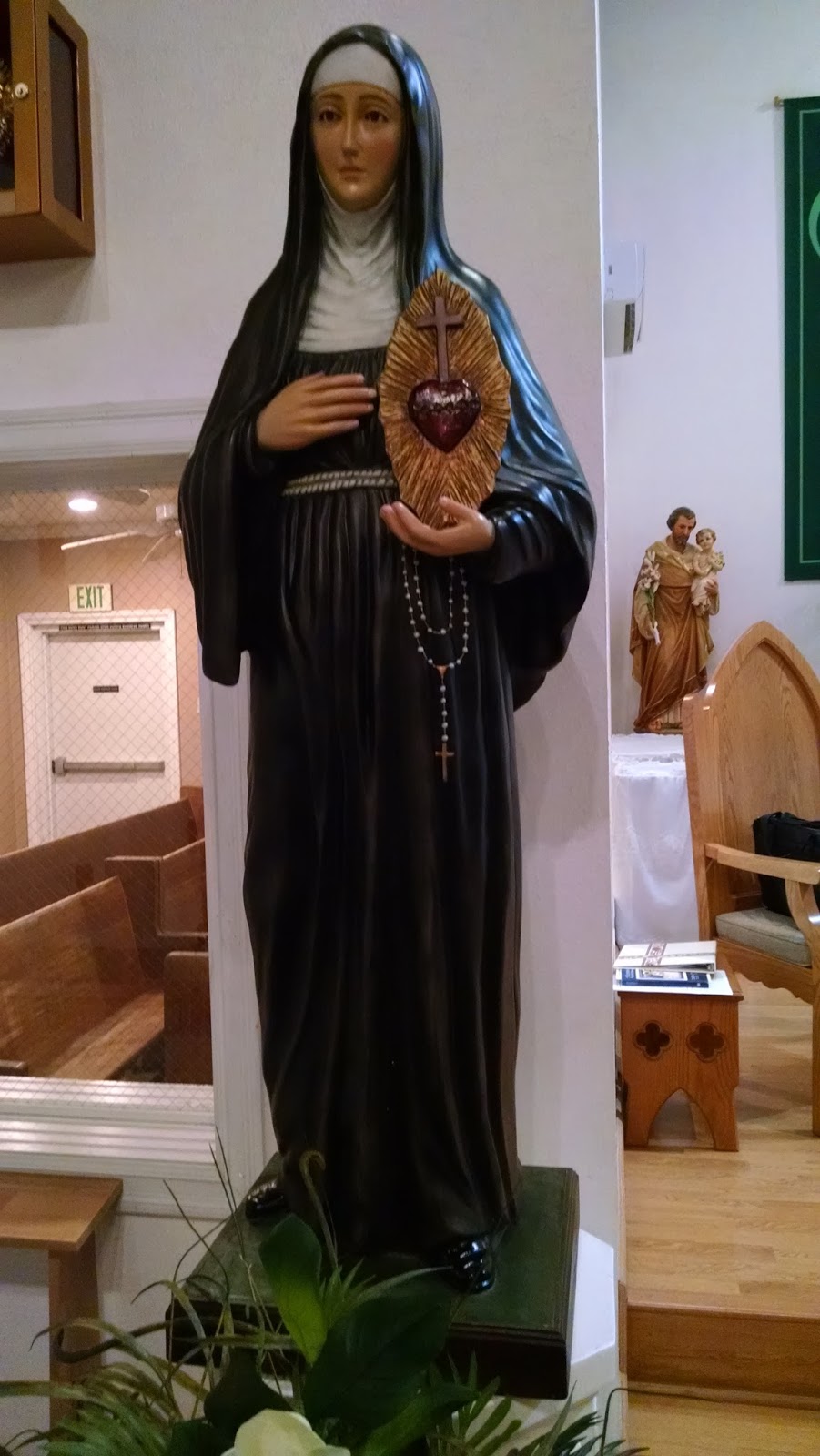
Recently I gave a mission at three clustered parishes in the Brawley, California area—St. Joseph in Westmorland and, in Brawley, St. Margaret Mary and Sacred Heart where there is a statue of the visionary to the left of the sanctuary and a painting in the parish hall.

When Jesus appeared to St. Margaret Mary, he told her that he was going to send his “faithful servant and perfect friend,” Fr. Colombiere to confirm the apparitions and to help her spread devotion to his Sacred Heart.  

When St. Margaret Mary protested that she was “a wretched creature, a poor sinner whose very unworthiness would be capable even of preventing of accomplishment” of his desire, he told her:

“Ah, poor innocent that you are, don’t you know that I make use of the weakest subjects to confound the strong, that it is ordinarily the smallest and the poor in spirit to whom I make my power visible with greater brilliance, so that they will not attribute anything to themselves?”

St. Claude wrote those words down in his spiritual journal.  He continued with these words to St. Margaret Mary in which Jesus refers to St. Claude, designated by “N”:

“It was then that He told me: ‘Turn to my servant N. and tell him from Me to do all he can to establish this devotion and to give this pleasure to My divine heart. Tell him not to be discouraged by the difficulties he will meet with, for they will not be lacking.  But he must learn that he is all-powerful who completely distrusts himself to place his trust in Me alone.’”

May we follow the example of these two saints and place all our trust in the Sacred Heart of Jesus!

Friday, November 18, 2016

Tears from the Heart of Jesus

Yesterday I finished leading a retreat for 75 women at the White House 
Jesuit Retreat House on the Mississippi River just south of St. Louis.  Here is my closing homily, based on the readings of the day—Revelation 5: 1-10 and Luke 19: 41-44.

Both of our readings contain tears.  John’s vision, in which no one can be found to open the scroll which will reveal God’s plan, leads him to weep.  In the Gospel, Jesus, as he approaches the city of Jerusalem, weeps over it.  He predicts the city’s destruction and cries.  Its future could have been one of peace, but in rejecting Jesus, the people rejected the one who came to show the way to that justice which alone is the basis for peace.

On July 8, 2013, Pope Francis visited an island in the middle of the Mediterranean Sea—Lampedusa.  He went there after many men, women, and children had drowned as they tried to get from Libya, North Africa, to Italy.  He asked:

“Has any one of us grieved for the death of these brothers and sisters? Has any one of us wept for these persons who were on the boat? For the young mothers carrying their babies? For these men who were looking for a means of supporting their families? We are a society which has forgotten how to weep, how to experience compassion – ‘suffering with’ others: the globalization of indifference has taken from us the ability to weep!”

If we have hearts like the Heart of Jesus, we will be moved to weep for such suffering and death.  Our prayers will be accompanied by tears. 

We weep but we do not despair.  As John’s vision continues in the first reading, he sees one who is able to open the scroll—the “lion of the tribe of Judah, the root of David”—Jesus.  He is the Lamb of God who was slain.  He perfectly fulfilled God’s plan for creation and in doing so became the victor over sin and death.  The vision ends with worship and hope.  Jesus has triumphed.  He has purchased for God those from every tribe and tongue, people and nation.”  He has “made them a kingdom and priests for our God, and they will reign on earth.”

We, the baptized, are now a “royal priesthood” (1 Peter 2: 9).  We are royalty not as the world thinks of it but as Jesus does. At the Last Supper he said that the kings of this world “lord it over” their subjects but it must not be so among his followers. “Rather, let the greatest among you be as the youngest, and the leader as the servant” (Luke 22: 25-26). 

We share in Christ’s priesthood by offering prayers and sacrifices.  The Sacred Chrism used to consecrate the walls and altars of new churches and the hands of newly ordained priests and everyone at their baptisms and confirmations—this sacred oil consecrates each of us for the sacred purpose of offering worship to God.  We do that at the Eucharist and in our daily lives. 

Moved, as the Heart of Jesus is, at the suffering in our world, we offer ourselves as He did for its ultimate salvation and peace.  

Sunday, September 18, 2016

St. Francis' Stigmata and the Year of Mercy

On September 17 I offered a spiritual workshop to the Sisters of the Third Order of St.Francis at their motherhouse in Peoria, IL.  While the universal Church remembers the Jesuit St. Robert Bellarmine in the liturgy that day, Franciscans celebrate a feast in remembrance of their holy founder’s receiving the stigmata.  However, there is an interesting connection which Fr. John Hardon, S.J.has noted:

“St. Robert Bellarmine had a great devotion to St. Francis of Assisi, and was especially devoted to honoring Francis' stigmata. Bellarmine urged that there be a special feast in honor of the five stigmata of St. Francis. Bellarmine had an important position in the Vatican and he made sure that the feast was introduced in the Church, despite strong opposition. As Providence arranged, Robert Bellarmine died on the feast of the stigmata of St. Francis, September 17.”

The readings for the Franciscan feast are Galatians 6: 14-18 and Luke 9: 23-26 and the following is the homily that I offered to the Sisters.

As Providence would have it, today, as we reflect on the Jubilee Year of Mercy, we are celebrating a feast in honor of St. Francis of Assisi’s stigmata, a gift that he received in the year 1224. The Year of Mercy and St. Francis’ stigmata go together quite well.  For if mercy is the greatest expression and embodiment of God’s love, and if the Church is the Body of Christ, then we are to embody God’s mercy and show it to the world in a visible way.  The greatest act of mercy is the Passion—the suffering, death, and resurrection of Jesus.

In his Message for the 2015 World Mission Day, Pope Francis wrote:  “Mission is a passion for Jesus and at the same time a passion for his people. When we pray before Jesus crucified, we see the depth of his love which gives us dignity and sustains us. At the same time, we realize that the love flowing from Jesus’ pierced heart expands to embrace the People of God and all humanity. We realize once more that he wants to make use of us to draw closer to his beloved people and all those who seek him with a sincere heart.”

Isn’t this what St. Francis did?  He prayed before Jesus crucified and experienced the depth of his love.  He shared Jesus’ passionate love for his people so much that he received the wounds of Jesus into his body. He embodied the Passion, the mercy of God.

On October 4, 1673, several months before Jesus appeared and revealed his Sacred Heart to her, St. Margaret Mary had a vision.  Here is how she described it: “On the feast of St. Francis, our Lord let me see in prayer this great saint, clad in a garment of light and unspeakable brilliance. He had been raised above the other saints to an extraordinarily high degree of glory, because his life was so like that of the suffering Redeemer who is the life of our souls and the love of our hearts. His glory was the reward of his great love for the Passion of our Lord, a love which rendered him worthy of the sacred stigmata and made him one of the great favorites of Jesus’ heart.”

In our first reading, St. Paul wrote that the world had been crucified to him and he to the world.  What does this mean?  I think it means that he shared Christ’s passionate desire for the salvation of the world.  This also describes St. Francis who took up the cross of poverty and labored for the salvation of souls.  He even risked his life in 1219 by going to Egypt to speak with the Sultan about Jesus.  Christian Crusaders were attacking the Sultan’s city and Francis was concerned as well for them because of their immoral life style.  Francis shared Christ’s passionate concern that no one be lost. 

The ultimate meaning of St. Francis’ stigmata is that he shared the desires and concerns of Jesus’ Heart so much that his body revealed the merciful wounds of Christ.  He was so configured to Christ that he embodied the mercy of God in a visible way.  

We too are called to be configured to Christ.  When we share his concern for the world and labor with him for the salvation of all, we embody the mercy of God.


We do so, always, with joy.  St. Francis once said: “It is not right for a servant of God to show a sad or gloomy face to anyone.”  More recently, in “The Joy of the Gospel,” Pope Francis said that Christians cannot be “sourpusses.”  The mercy which we embody is joyful.  Being “merciful like the Father,” as the motto for this Extraordinary Jubilee Year tells us, means sharing God’s joy in being merciful.  In the parables of Luke 15, Jesus tells us that there is great joy in heaven when the lost are found, when sinners repent and receive the mercy that God always has in store for them.  May our celebration of this feast and our ongoing Jubilee celebration help us to embody the joyful mercy of God.

Thursday, August 4, 2016

A First Mass Homily

Homily for the First Mass of Fr. Vincent Strand, S.J. 
St. Bruno Parish, Dousman, WI -- June 5, 2016
1 Kings 17: 17-24;  Galatians 1: 11-14a, 15a,c, 16a, 17, 19;  Luke 7: 11-17

Two women.  Both are heart-broken. They have lost their husbands, and now, their own flesh and blood, their sons.

The Prophet Elijah was a boarder at one widow’s home during a time of drought and famine.  God miraculously provided food for the three—the prophet, the widow and her son—but now the son dies.  Elijah feels her pain.  He prays.  And God brings the boy back to life.

Jesus was recognized as “a great prophet,” in the tradition of Elijah.  He feels the widow of Nain’s pain and is moved with pity. Then, with his own power because he is Son of God, he brings the youth back to life.

Commenting on this story, Pope Francis said:

This “compassion” is God’s love for humanity, it is mercy--thus the attitude of God in contact with human misery, with our destitution, our suffering, our anguish. The biblical term “compassion” recalls a mother’s womb. The mother in fact reacts in a way all her own in confronting the pain of her children. It is in this way, according to Scripture, that God loves us. What is the fruit of this love and mercy? It is life! … The mercy of Jesus is not only an emotion; it is a force which gives life that raises man.

The restoration to life of the two sons is beautiful, but temporary. They will die again.  Their being raised to earthly life is a sign of something better. Because Jesus rose from the dead, he has power to give not just a temporary extension of life, but eternal life.  He can raise people from the dead to live forever with him in heaven.  This is part of the Creed which we proclaim together:  “I look forward to the resurrection of the dead and the life of the world to come.”

Jesus shares this power to give new and eternal life with the Church, his Body. 

Vincent, Jesus shared this power with you yesterday. Jesus called you and yesterday he empowered you to heal broken hearts and souls.  Pope Francis, in a recent interview book entitled “The Name of God is Mercy,” said that the Sacrament of Reconciliation is not like going to the dry cleaner to get stains removed.  It’s much more, much deeper. It involves healing wounds.  You are now an instrument of this healing and life-giving grace.

St. Paul, as we heard in the Second Reading, experienced the merciful love of God that took him from being a persecutor and zealot to proclaiming the love of God revealed in Jesus.

Pope Francis, at age of seventeen, on September 21, 1953, went to confession and had such a profound experience of God’s merciful love—and the healing and peace that it alone can give—that he chose to become a Jesuit priest.  You have also experienced the profound merciful love of Jesus that has drawn you to this vocation.

In the Novitiate you wrote:

As I grew more and more aware of God’s great love for me, suddenly my vocation seemed simple: to bring the love of Jesus to the world. For me, the love of Jesus was symbolized by the love of his Heart. I felt Christ calling me to share the love of his Heart, to be an apostle of his Heart. This, it seemed to me, was at the core of what it means to be a Jesuit. I knew it was to the Society of Jesus that God was calling me.


The image of the Heart of Christ that you chose for your ordination card is striking.  It’s not pretty, not sentimental. It was etched into a wall in one of the cells in the starvation bunker in Auschwitz. It’s just down the hall from St. Maximilian Kolbe’s cell. 


And on the wall opposite this image is another—
the one that is spoken of in the quote from Pope
Benedict XVI that you chose for the back of your card.  It’s a crucifixion scene—the Cross.

[We know that in the end—as Saint Ignatius of Loyola saw so clearly—the only real “standard” against which all human reality can be measured is the Cross and its message of an unmerited love which triumphs over evil, sin and death, creating new life and unfading joy. The Cross reveals that we find ourselves only by giving our lives away, receiving God’s love as an unmerited gift and working to draw all men and women into the beauty of that love and the light of the truth which alone brings salvation to the world.]

In that place of darkness—symbol of humanity’s inhumanity, of sin, and the hatred and violence it brings, there are images of love—the Cross and the Pierced Heart

You were ordained yesterday to bring the light of Christ’s love into the darkness. You will do this through the Sacrament of Reconciliation. 

You will do this through the prophetic ministry of the Word, speaking words that challenge us to believe in the love of God and to have hope when it is so easy to despair; to, as some have said, comfort the troubled and trouble the comfortable; to speak and write the truth that saves and to do so with love.

But more, you are now able to bring to people the very One who forgives, heals, and gives eternal life.  When you celebrate the Eucharist, Christ makes himself present through you. He makes present his life-giving death on the cross and his resurrection. Through you the bread and wine become the Body and Blood for us to receive and to be transformed. 

Pope Benedict XVI spoke of this in Cologne Germany at World Youth Day 2005. Your brothers were there, but you were not able to go because you had just entered the Novitiate.

Speaking about the Last Supper, Pope Benedict said:

By making the bread into his Body and the wine into his Blood, he anticipates his death, he accepts it in his heart, and he transforms it into an action of love. What on the outside is simply brutal violence - the Crucifixion - from within becomes an act of total self-giving love. This is the substantial transformation which was accomplished at the Last Supper and was destined to set in motion a series of transformations leading ultimately to the transformation of the world when God will be all in all.

In their hearts, people always and everywhere have somehow expected a change, a transformation of the world. Here now is the central act of transformation that alone can truly renew the world:  violence is transformed into love, and death into life.

To use an image well known to us today, this is like inducing nuclear fission in the very heart of being - the victory of love over hatred, the victory of love over death. Only this intimate explosion of good conquering evil can then trigger off the series of transformations that little by little will change the world.

All other changes remain superficial and cannot save. This first fundamental transformation of violence into love, of death into life, brings other changes in its wake. Bread and wine become his Body and Blood.

But it must not stop there; on the contrary, the process of transformation must now gather momentum. The Body and Blood of Christ are given to us so that we ourselves will be transformed in our turn. We are to become the Body of Christ, his own Flesh and Blood.

Through your service at the altar, Vincent, we receive the Bread of Life, the food that transforms us, in Pope Benedict’s words, into “the Body of Christ, his own Flesh and Blood.”  As “the Body of Christ, his own Flesh and Blood,” all of us are now empowered to bring the merciful love of God into our own little corners of the world. The Eucharist, of which you are now a special servant, makes this possible.

We thank God for the call that you received and the grace with which you were able to accept the call. 

St. John Vianney, patron saint of all priests, said:

"The priesthood is the love of the Heart of Jesus.”

This love involves sacrifice, something you’ve obviously learned from the beginning, from the sacrifices that you’ve seen your family make. Thank you for offering yourself to be a priest, a Jesuit, an apostle of the Heart of Jesus.

Tuesday, June 7, 2016

A Jesuit Ordination

Last Saturday I participated in the ordination of Jesuit Fr. Vincent Strand.  It was a happy and special time for me because I had been his spiritual director when he was discerning his vocation as a student at Marquette University.  From those days to the present he has been a strong member of the Apostleship of Prayer.  Here's something he wrote when he was a Jesuit novice, In it he wrote about how making a daily offering led to him offering every day of his life as a Jesuit priest:

            "I remember well my first encounter with the Apostleship of Prayer.  I was a freshman at Marquette University and accustomed to attending daily mass in the basement chapel of Gesu Church.  Each day while en route to my pew, I would pass a table filled with popular devotional materials: endless holy cards and novenas, gaudy plastic rosaries, green and brown scapulars, and there too, the AOP leaflets with the Holy Father’s monthly intentions.  Assuming that the AOP was one more dusty devotional practice that perhaps had a place in the 50´s Catholicism of my grandparents, but certainly had no relevance for a third-millennium college student, for months I passed these leaflets without a second thought.  One day, however, perhaps simply out of curiosity, I picked up a leaflet and perused its contents, expecting to find one more antiquated novena to some obscure saint.  I was shocked by what I found.  For here was a list of intentions that was anything but outdated, a list of intentions which reflected my deepest hopes for the world, a list of intentions which was as broad and diverse as the whole of the Church’s mission. 

            "Yet something else in that small leaflet struck me as well, a small prayer that would forever change my spiritual life: the daily Morning Offering.  Father General Peter Hans Kolvenbach once wrote of the Morning Offering: “Experience shows that this act, both simple and profound, changes one's life.”  It did so for me.  As I began daily offering my life to Jesus, the question started to loom: If you give each day to him, why not your whole life?  Soon I was discerning a religious vocation.

            "The fact that the Society of Jesus has been entrusted by Christ himself with the responsibility of propagating the devotion to his Heart—a responsibility institutionalized by the AOP—played a significant role in my decision to apply to the Society of Jesus.  During my years of discernment, I thought seriously about a number of options: Married laymen? Dominican? Carmelite? Diocesan priest?  Amidst this sometimes confusing cloud of options, my spiritual director continually asked me: What is your deepest, truest desire?  As I grew more and more aware of God’s great love for me, suddenly my vocation seemed simple: to bring the love of Jesus to the world.  For me, the love of Jesus was symbolized by the love of his Heart.  I felt Christ calling me to share the love of his Heart, to be an apostle of his Heart.  This, it seemed to me, was at the core of what it means to be a Jesuit.  I knew it was to the Society of Jesus that God was calling me.

            "The importance of devotion to the Sacred Heart of Jesus and the AOP has only grown during my time in the Society.  Intriguingly, I have observed the same phenomenon in the lives of many other young Jesuits.  Perhaps this was most evident for me in the days of sharing which followed the long retreat in my novitiate last year, when a number of men who previously had no formal contact with devotion to the Sacred Heart spoke of the importance of the symbol of Jesus´ Heart for them during the Spiritual Exercises.  Suddenly, they too were convinced of the need to spread this devotion—this message of love—to all the world.    

            "I am convinced that the AOP has an indispensable part to play in the future of the Catholic Church in America.  The innate spirituality of the AOP provides an answer to many trends of the contemporary world.  In an age when young Catholics desire something radical, something heroic, something whole, the spirituality of the Morning Offering requires a complete gift of self.  In a time when the faithful, especially youth, have a growing love of the Eucharist, the AOP offers a spirituality which is intrinsically Eucharistic.  In a Church which has finally come to a clearer understanding of the universal call to holiness, the AOP provides an avenue for the sanctification of one’s life in the midst of the world.  In an age when globalization continues to shrink the world and makes us aware that we are truly neighbors and in solidarity with the whole human family, the AOP places us in a fraternity of prayer with men and women in every corner of the globe, praying for intentions which are universal in scope.  In a world marked by a great yearning for peace and justice, the AOP provides us with intentions focused on the most pressing needs of social justice throughout the world.  In an age of increased secularization which has resulted in a fervor for a new evangelization, the AOP fosters a missionary spirit among its members. 

            "Perhaps these are some of the reasons why there is a renewed interest in the AOP among so many young Jesuits.  But, in truth, I think there is a deeper and simpler reason, a reason which has been articulated time and time again by Jesuit spiritual writers, by countless Father Generals, and recently by men such as Pedro Arrupe and Karl Rahner: devotion to Christ’s Heart is something essential to the Society of Jesus.  Thus as something essential, as long as there are Jesuits, there will be a zeal for spreading the message of love of the Sacred Heart. 

"While for a time it may have appeared to be on the wane, interest in the Sacred Heart among Jesuits is not disappearing.  No, to the contrary, it appears to be growing.  In one of his last and most famous letters to the Society, “Rooted and Grounded in Love,” Pedro Arrupe stated:  “I am convinced that there could be few proofs of the spiritual renewal of the Society so clear as a widespread and vigorous devotion to the Heart of Jesus.”  I pray that this saint’s words were prophetic and that interest in the Sacred Heart among young Jesuits is indicative of a greater spiritual renewal in the Society of Jesus.  For as always, the world is in great need of knowing the love of Christ’s Heart.  May Jesuits always be at the forefront of spreading this love to the whole world."   


Friday, May 29, 2015

Post-Pentecost

When I was growing up before the Second Vatican Council, the Sundays after Pentecost were known as the Third or Fourth or Twenty-fourth Sunday after Pentecost. That gave the feast of Pentecost an importance that I fear has been lost as we return now to Ordinary Time, which really means Ordered or Numbered Time.  The time after Pentecost, both the first one centuries ago and our celebration last Sunday, is the time in which the Church carries on the mission of preaching the Gospel and reconciling.  This two-fold mission was made clear in the readings for Pentecost.

The first reading (Acts 2: 1-11) tells the story of the coming of the Holy Spirit at the first Pentecost Sunday. The power of the Holy Spirit was expressed in two ways--wind and fire.  Jesus compared the Spirit to wind in John 3: 8: "The wind blows where it wills, and you can hear the sound it makes, but you do not know where it comes from or where it goes; so it is with everyone who is born of the Spirit."  We get the word "respiration" from the word "spirit" and the Hebrew word for "spirit" is "ruah" or "breath."  The Holy Spirit is the Breath of God.

On the first Sunday after Pentecost we celebrate a feast in honor of the Most Holy Trinity. God the Father, the Creator, reveals the divine nature of love by creating. In doing so we see that God is "for us."  The Second Person of the Trinity is "Emmanuel, which means 'God is with us'" (Matthew 1: 23).  The Third Person of the Blessed Trinity, the Holy Spirit, is the breath that shows us God is "within us."  We are temples of the Holy Spirit.  God is as close to us, and as essential, as our breath.

Fire gives light and warmth. It also purifies and unites.  Precious metals like gold are placed in a furnace to melt and be purified of dross or impurities.  The Holy Spirit comes to give the light of truth, to warm and heal hearts, and to purify us so that we may be one.

Sin divides and separates.  Early in history (see Genesis 11: 1-9), human beings rejected God's call to fill the earth. In fear, they clung together and tried to attain the glory and power of God on their own.  To fulfill the plan for human beings to fill the earth, God confused their language and scattered them.  But this scattering and confusion of language led to sinful divisions.  Diversity became the source of conflict rather than richness in unity.  The coming of the Spirit at Pentecost began the process of reconciliation and unity.  The tongues or languages remained diverse but there was an amazing and miraculous understanding.

Before the Spirit came at Pentecost, the Son of God had to suffer, die, rise, and ascend.  Jesus prepared the Church to carry on his work when he met the apostles in the upper room, gave them his peace, sent them as the Father had sent him, and empowered them to carry on his work of reconciliation by breathing on them (John 20: 19-23).  He said: "Receive the Holy Spirit. Whose sins you forgive are forgiven them, and whose sins you retain are retained."  Forgiveness requires two parties--one who extends forgiveness and the other who receives it. God is always ready to forgive, but people may reject that forgiveness. People may not recognize that they have done anything wrong that requires forgiveness and so they do not ask for it nor receive it.  These are the sins that are "retained."

In the Sacrament of Reconciliation Jesus, through the priest, sends the Holy Spirit upon those who ask for mercy. The Spirit comes to purify and heal.  There is no individual sin.  As St. Paul wrote in the second reading (1 Corinthians 12: 3b-7, 12-13), there is one body that consists of many parts.  Each of us is a cell within the Body of Christ.  The health of one cell affects the entire Body, just as one cancer cell affects a person's physical health.  Human beings are made in the image and likeness of God who is a Trinity of Persons.  God is not an amalgam of individuals but a communion of Persons. Made in God's image and likeness we are made for communion.  Theologians have said that the Holy Spirit is the love between the Father and the Son.  The Spirit is the love that brings the Body of Christ together into one.

One of the invocations in the Litany of the Sacred Heart is "Heart of Jesus, burning furnace of charity."  The fire that burns in the Heart of Jesus is the Holy Spirit who purifies, heals, and unites all who come to the Sacred Heart of Jesus.  In that Heart and through the power of the Holy Spirit, all human beings can truly be one, one with God and one as God's family.

May the coming month of June, dedicated as it traditionally is to the Sacred Heart of Jesus, and the following Post-Pentecost months until Advent, make us one in the Heart of Jesus.

[The icon in this post is from the hand of Brother Christopher, a Carmelite Hermit. His God-inspired work can be found at the website for the Carmelite Hermitage of the Blessed Virgin Mary.]

Monday, April 27, 2015

St. Peter Canisius and The Sacred Heart

The liturgical calendar the Jesuit St. Peter Canisius on December 21, the date of his death in 1597, but today the Society of Jesus celebrates his feast day. After he was canonized and declared a doctor of the Church in 1925 his feast was assigned to this date and was so celebrated until the calendar was changed in 1969.  Jesuits continue to honor him on this day because the days right before Christmas focus on the coming celebration of the Nativity and give less attention to the saints.

St. Peter Canisius shows that the Church had a strong devotion to the Sacred Heart of Jesus before the apparitions to St. Margaret Mary in the 1670's.  St. Mechthilde of Hackeborn, a Benedictine nun who lived in the 1200's, wrote a book of prayers to the Sacred Heart.  St. Peter Canisius made a copy of these prayers, carried them with him wherever he went, and held fast to them on his deathbed.

He is known as the second apostle of Germany (after St. Boniface) and when he was about to set out to begin his mission there he wrote the following prayer:

"My Savior, I seemed to be gazing at the Heart of your Sacred Body with my own eyes. It was as if you opened it to me to drink from it as from a spring, inviting me to draw the waters of salvation from these springs of yours. I was filled with longing that the waters of faith, hope, and charity would flow from your Heart into me. ... Then I dared to touch your beloved Heart and bury my thirst in it; and you promised me a robe woven in three parts to cover my naked soul and help me greatly in my undertaking. These three parts were peace, love, and perseverance. Secure in the protection of this garment, I was confident that I would lack nothing, and that everything would turn out for your glory."

Peace, love, and perseverance: gifts from the Heart of Jesus. They allowed St. Peter to write a popular catechism and to explain the doctrines of the Catholic faith to Protestants and Catholics alike during a time of upheaval in Germany.  May the Church today receive these same gifts from the Sacred Heart of Jesus!

Wednesday, February 18, 2015

The Beginning of Lent

I led a day of recollection today for the seminarians at St. Francis de Sales Seminary in Milwaukee. It was a quiet and prayerful day and what follows is a summary of my homily.

In our first reading (Joel 2: 12-18), God tells us to return "with your whole heart" and to "rend your hearts, not your garments."  We are half-hearted.  Our hearts are divided.  We need our hearts to be healed, to be made whole.  We need to open our hearts to God so that the Holy Spirit may pierce and soften these sin-hardened hearts.

What divides our hearts?  What hardens them?  The self-centeredness of sin.

Last week the first readings at Mass were from Genesis, the story of the first temptation and sin.  Our ancestral parents had hearts open to God, but fear and mistrust closed and hardened them. They were tempted to believe the serpent who suggested that God might not be telling them the truth when warning them that the fruit of a certain tree would bring death. They mistrusted God and thought it would be better to be independent, to get control, to be like gods who could determine for themselves what was right and what was wrong, what was good and what was bad.

They ate and the effect was immediate. They felt shame in each other's presence.  They were no longer open to each other but covered themselves. When God came for their daily stroll, they hid.  The man's response shows the self-centeredness that began the hardening of his heart, closing him off from God and the woman. He said: "I heard you in the garden; but I was afraid, because I was naked, so I hid myself.  Me, me, me.  The world now revolved around him.

Then, when God pointed out that this response clearly indicated he'd eaten of the fruit, the man responded, "It was the woman you put here...."  He blamed his partner and God.  Turned in on himself, the man turned against God and his neighbor.

Sin works the same way in our lives.

Those who work in the Church and offer their lives in service of others are not immune from sinful self-centeredness.  It creeps into our relationship with God and into ministry. In the Gospel (Matthew 6: 1-6, 16-18), Jesus warns against "righteous deeds" which are done to gain others' attention and affirmation.

We need this time of Lent for conversion.  Our divided hearts, which seem to be serving God while all the while serving themselves, need to be made whole and undivided.  We need this time to develop hearts like the Heart of Jesus which he described as "meek and humble."  Humble hearts don't pray and serve in order to receive glory.  They give and serve without seeking a reward because they are motivated by love.

Jesus was so in touch with the infinite love of the Father that he was free to love totally with great freedom, with a whole and undivided heart.  Knowing the love of the Father, he, in the words of our second reading (2 Corinthians 5: 20 - 6: 2) became sin.  Just as he reached into the isolation of the leper in last Sunday's Gospel (Mark 1: 40-45), touched him, and made himself unclean in the process, so Jesus reached into human darkness and took upon himself the sins of the world when he was nailed to a cross.  With his attention focused totally on the God and those whom God sent him to save, Jesus made a total offering of himself.

Now he calls us to renounce the self-centeredness of sin that hardens and closes our hearts. We begin this time of purification and healing by remembering that we are dust. We are not God.  We are not in control.  Nor do we have forever for our hearts to be made more like the Heart of Jesus.  "Behold, now is a very acceptable time; behold now is the day of salvation."

Sunday, November 23, 2014

Jesus Christ the King of Hearts

Jesus Christ is King, but he reigns not with force or violence or human power. He does not force people to do his will, to be good, to follow his Law. The power with which he reigns and rules is divine power. And since God is love, he reigns with the power of love.

His throne is the floor, where he kneels to wash the feet of his disciples, teaching them that, while the kings of this world “lord it over” their subjects, it must not be like that for his followers.  The greatest must be the servant. The first must be the last.

His throne is the cross, where he shows a power greater than all worldly power.  It’s the power of love, a love unto death, a love that will overcome death and give life. To his pierced heart on the cross he will draw all people to himself. He will attract them to himself rather than forcing himself upon them.

The power of this love overcomes hatred with mercy as Jesus prays for those killing him and asks the Father to forgive them. The power of this love overcomes every enemy, including death.

Each of us will die, but that won’t be the end of us. We are made for more. We will enter eternal life where we will be judged. The final judgment depicted in Matthew 25: 31-46 is not something imposed on us from outside, but is the natural conclusion or outcome of our lives.

St. Catherine of Siena once said, “All the way to heaven is heaven.” That being so, all the way to eternal alienation from God and the saints begins right here as well.

The striking thing about the judgment scene as described by Jesus is that people do not recognize him in the poor and suffering. Those who act compassionately do so not to gain a reward, or because they were told to do so and are afraid of punishment. Their actions come naturally to them. They appear to be instinctively charitable. Perhaps, when they see someone suffering, they imagine what it would be like to be in their circumstances, and they respond. They see others with the eyes of their hearts and are moved by their suffering.

Those who do not recognize Jesus in the suffering see something else. They see in the other a drain on their time and energy and resources. They see an annoyance, a frustration, a threat, an enemy.
Jesus tells us to see others with an instinctive charity, to see others with hearts that are moved with pity for their suffering. We are to see others with a heart like the Sacred Heart of Jesus which sees them as precious to the Father and which so desires their well-being that it is willing to die for them.
Our challenge is to see all people this way.

They include the homeless person begging with a sign where we are stopped in traffic. They include immigrants and prisoners. And yes, they include politicians on both sides of the aisle. How do we view the people we see on the television news or read about in the papers? Do we see them as persons precious to Jesus because he shed his Precious Blood for them?  Or do we mentally dispose of them as garbage.

If we ignore them or reject them we will find ourselves living as “goats” in the kingdom of darkness, a darkness that begins here and now, in our hearts and all around us.

One way that we dismiss and dispose of people is gossip. This is a particular concern of Pope Francis.

In his General Audience of September 25, 2013, Pope Francis said: “Let each one ask him or herself today, ‘do I increase harmony in my family, in my parish, in my community or am I a gossip? Am I a cause of division or embarrassment?’ Gossip does harm. Gossip wounds. Before Christians open their mouths to gossip, they should bite their tongue! To bite one’s tongue: this does us good because the tongue swells and can no longer speak, cannot gossip. Am I humble enough to patiently stitch up, through sacrifice, the open wounds in communion?”

Good questions which challenge us to live right now in the light of heaven with its charity and peace. Doing this, we enthrone Jesus as King of our hearts.

Lastly, in speaking about this Gospel in his General Audience of November 27, 2013, Pope Francis said that if we have this instinctive charity we will have no fear. We will be able to face death without fear. The way to follow Jesus into the heavenly Kingdom prepared for each of us is charity. He said:

“A sure path comes by caring for the bodily and spiritual wounds of our neighbor. Solidarity in sharing sorrow and infusing hope is a condition for receiving as an inheritance that Kingdom which has been prepared for us. The one who practices mercy does not fear death. And why does he not fear it?  Because he looks death in the face in the wounds of his brothers and sisters, and he overcomes it with the love of Jesus Christ. If we will open the door of our lives and hearts to our brothers and sisters, then even our own death will become a door that introduces us to heaven, to the blessed homeland, toward which we are directed, longing to dwell forever with God our Father, with Jesus, with Our Lady and with the Saints.” 

Amen.


Wednesday, September 24, 2014

Not Fair, but Generously Merciful

Today is the last night of a parish mission that I am leading at St. Justin Martyr Church in the St. Louis area. The following is a summary of my homily from last Sunday, the 25th Sunday in Ordinary Time, Cycle A.


When I was growing up we played "Hide and Seek."  Everyone is familiar with how that goes. If you are "it" you have to close your eyes while the others all run and hide. Then you seek them and tag them before they can reach "goal" which we pronounced "gool."  If you put your hands over your eyes but then spread your fingers to see where people went to hide you might hear back "No fair peeking." 


Children have an innate sense of fairness. If a teacher plays favorites or treats the girls better than the boys they will complain that the teacher isn't being fair. And vice versa.  Children don't learn fairness, though they often have to be reminded. A victim of unfairness knows immediately that something isn't right.  This sense of fairness seems to be part of one's conscience--an innate sense of right and wrong.


That being said, most of us hear today's Gospel (Matthew 20: 1-16a) with the parable of the workers who labor for various numbers of hours in a vineyard yet get the same pay and we react, "That's not fair!"  That's especially not fair if we consider that perhaps the reason why the workers who were hired at five weren't there at the crack of dawn because they were sleeping in.  Should such laziness be rewarded?


Remember: the parables of Jesus were designed to shock people--his listeners then and all of us now--into thought and action.


What was Jesus trying to teach us with this parable? What did he want us to think and to know?

Our first reading (Isaiah 55: 6-9) gives us a clue. Through the prophet, God, "who is generous in forgiving," tells us "my thoughts are not your thoughts, nor are your ways my ways." 


The parable Jesus told was a description of "the kingdom of heaven."  Every human being is created for heaven--for union with God and the communion of saints. But from the beginning we have rejected God's desire and plan.  Yet God persisted.  As the landowner in the parable is "generous" so is God.  To save us from our sins and the alienation and destruction they cause, the Son of God took flesh, suffered, and died.  He took upon himself the penalty of our sins.  Then he rose from the dead and shared the reward of his obedient love with disobedient humanity.


We did not earn it.  He did not deserve it.  This was totally unfair, but it was totally merciful.


This is our faith. It's what we celebrate every time we gather for the Eucharist.


But remember, parables are designed to not only shock us into thought but also into action.  What is the action Jesus hoped to achieve with this story?

That we would be as generous and merciful as our Landowner God is.  That we would desire and then pray and work for the salvation of all.  That we would want everyone in heaven as much as God does.

That's difficult. We all have people that we don't like.  We have enemies and the thought of being with them for eternity in heaven sounds more like hell!

It is difficult and perhaps impossible to be as merciful as God is merciful. Yet we are called to be such and the power to be merciful is a divine power that is given to us in the Eucharist.  There we receive the Heart of Jesus when we receive his Body and Blood.  There our hearts are transformed to be more like the generously merciful Heart of our Savior.

Sunday, August 31, 2014

On the Feast of St. Jeanne Jugan


August 30 was the feast of St. Jeanne Jugan, the foundress of the Little Sisters of the Poor. I celebrated Mass at St. Joseph’s Home in Palatine, IL. My homily was based on these special readings: Isaiah 58: 6-11; 1 John 3: 14-18; and Matthew 5: 1-12a.

We are celebrating a great saint today—Jeanne Jugan. Of course she would shudder at those words. She aspired not to be great but to be little.  She once said: “Be little, little, little; if you get big and proud, the congregation will fall.” And another time, “Only the little are pleasing to God.”

Why? Because this is God’s way. How did God choose to save the world? Not with worldly power and glory. Not with an army of angels that would force people to follow God’s way. God saved the world by becoming little—a little baby.

In his homily at Midnight Mass on Christmas 2008, Pope Benedict said that our first experience of God is one of distance. God seems so far above and beyond us. This transcendent God drew near, bridging the distance by becoming one of us. Pope Benedict went on to say that our experience of God is also one of glory and grandeur which provoke fear in us. So God became a tiny baby in order that we would no longer fear but love, for people love tiny, newborn babies. 

St. Paul wrote that the Son of God became poor in order to make us rich. He emptied himself and became little and in need of love and care. He shared our life with its sorrows and joys, its sufferings, both physical and spiritual when he felt totally abandoned as he hung dying on a cross. He shared in death itself.

The cross looks like a failure, but God’s ways are not ours. The failure of the cross is really a triumph in which the power of love wins over sin and death. 

“Love.” That word is used in so many different ways that it has lost its meaning. We talk about loving our pets and ice cream. We love whatever and whomever makes us feel good, gives us pleasure. It’s all about “me” and how I am feeling.

In our second reading St. John says that love is not about feelings and not about words, but about deeds and action.

This is why “hospitality” is such an important word. Hospitality is love in action.

It begins in hearts—hearts open to others, to all, especially the poor and the sick, the neglected and rejected of what Pope Francis calls our “disposable culture.”  We must open our hearts to them just as the Sacred Heart of Jesus is open to them.

This is what Jeanne Jugan did. Her heart was open to the elderly poor. She felt their need.  She had compassion and suffered for their sufferings.  And she responded. She not only opened her house to them; she gave up her own bed to that first poor blind woman that she carried into her home. 

This spirit of hospitality lives on today in the Little Sisters of the Poor. Their Constitutions state: “Consecrated hospitality is, in the midst of the world, a witness to the mercy of the Father and the compassionate love of the Heart of Jesus.”

Hospitality means opening our hearts, our doors, our wallets.  But ultimately the greatest hospitality is sharing the life of the other. Jeanne Jugan shared in the poverty of the poor, becoming a beggar for the beggars.  Her complete trust in Providence, not having endowments or investment income, continues today as the Little Sisters depend upon the generosity of others.

In his Lenten Message this year, Pope Francis said that Christ did not love us like someone who gives a little out of his or her abundance. He gave all and sacrificed his very self.

So did St. Jeanne Jugan who wanted to be known by her religious name Sister Mary of the Cross. She shared in the sufferings of the Crucified One as did His Mother who stood under the cross and suffered as only a mother could watching her son suffer and die. Mary joined her sufferings to those of Jesus for the salvation of the world. St. Jeanne also offered herself and sacrificed what was most dear to her, her own congregation. It was taken from her when she was relieved of any leadership position and lived a hidden life in the novitiate where the young did not even know who she was.

She was able to do this because she had become little. She had become the last and least. She found her strength and consolation in one place—in Jesus, who assured her that blessed are the poor in spirit, blessed are those who mourn, blessed are the meek, blessed are those who hunger and thirst for righteousness, blessed are the merciful, blessed are the pure of heart, blessed are the peacemakers, and blessed are those who suffer persecution.

When he canonized her in 2009, Pope Benedict said: “In the Beatitudes Jeanne Jugan found the source of the spirit of hospitality and fraternal love, founded on unlimited trust in Providence, which illuminated her whole life.”

He went on to say: “This evangelical dynamism is continued today across the world in the Congregation of the Little Sisters of the Poor, which she founded and which testifies, after her example, to the mercy of God and the compassionate love of the Heart of Jesus for the lowliest. May St. Jeanne Jugan be for elderly people a living source of hope and for those who generously commit themselves to serving them, a powerful incentive to pursue and develop her work!”

We gather for the Eucharist, a word that means “thanksgiving.” We are grateful for the Sisters who faithfully live the charism of St. Jeanne Jugan. We are grateful for the staff, workers, and volunteers who share in that charism. We are grateful for the benefactors who support the Sisters in following their charism of total trust in God.  But most of all, we are grateful for the residents who give us an opportunity to love and care for Jesus who said “Whatever you do for the least of my brothers and sisters, you do for me.”

Friday, July 18, 2014

Mercy and Sacrifice


There is a story that the disciples of Jesus were criticized by the Pharisees for breaking the sabbath when they picked heads of grain and ate them as they walked through a field (see Matthew 12: 1-8, Mark 2: 23-28, Luke 6: 1-5). Jesus defends them by pointing to similar situations in Israel’s history. He also declares that as “Son of Man”—a title that appears in the book of the prophet Daniel (2: 13-14) and that indicates divine kingship—he is Lord of the sabbath. 

In Mark’s version of this story, Jesus declares that the “sabbath was made for man, not man for the sabbath.” The sabbath was instituted by God for the sake of justice: so that the human person could give God the worship that is God’s due. It was instituted by God for the sake of human dignity: so that human beings could have the rest and leisure they require and which imitates God whom Genesis said rested on the seventh day after all the work of creation (2: 3).

Matthew has Jesus quoting a verse from the prophet Hosea: “I desire mercy, not sacrifice (Hosea 6: 6). What is translated here as “mercy” is also the word “love.”  God wants love and mercy and not the empty sacrificial rituals that Hosea inveighed against.  This is the “sacrifice” that God does not want. However, there is another “sacrifice” that is essential to love and mercy.  It is the sacrifice of self, the denial of self-interest, the rejection of retaliation.

The greatest sign of mercy and love is the sacrifice of Jesus on the cross. He died not for the righteous but for sinners (Romans 5: 8). He died begging pardon for those who tortured and killed him and even made excuses for them (Luke 23: 34).

July 19 is the anniversary of Fr. Lawrence Jenco’s death in 1996. Fr. Jenco was a Servite priest who was the regional director of Catholic Relief Services in Lebanon in 1985. He was kidnapped and spent the next 564 days in captivity as a hostage. He was blindfolded most of the time and transported from place to place in a secret compartment under trucks where he was almost asphyxiated by the noxious diesel fumes. He was beaten. After his release he wrote a book—“Bound to Forgive”—and he began the first chapter with these words of Jesus as recorded by Luke: “But I say to those who listen, Love your enemies, do good to those who hate you, bless those who curse you, pray for those who abuse you” (6: 27-28). This holy priest forgave his captors and tormenters and even asked their forgiveness for the times that he himself had harbored hatred and thoughts of revenge in his heart. (I wrote about this in another blog entry here.)

What gave Fr. Jenco the ability to forgive in this way? The Eucharist. He heard the Word of God and allowed it to enter his heart to transform it from a heart hardened by a righteous anger that had become bitter hatred to a heart of mercy and love. He received the Word of God-Made-Flesh in Holy Communion and allowed the Eucharistic Heart of Jesus to transform his heart. 

Past, current, and, no doubt, future events reveal a world desperately in need of conversion, of mercy and love. That will require sacrifice, a sacrificial mercy that begins here, with my heart and yours. Heart of Jesus, make our hearts like yours!

Thursday, July 17, 2014

Venerable Nano Nagle


I have been giving a retreat this week to Nano Nagle’s Sisters in Aberdeen, South Dakota. They are known as the Sisters of the Presentation of the Blessed Virgin Mary.  But who was Nano?

Honora Nagle was born in County Cork, Ireland in 1718 and was soon called by the affectionate name “Nano.” This was time of persecution for Catholics in Ireland. They were forbidden to teach, open up schools, or travel elsewhere for an education. Some of the Nagle family were merchants who had connections on the continent and Nano was able to travel to Paris to attend school. In 1746, after her father’s death, she returned to Ireland and, in violation of the laws, began teaching. She set up her first school in 1754 and very soon started seven more. She was never arrested and in 1775, with other women who joined her in the work, she founded the Society of Charitable Instruction of the Sacred Heart of Jesus which in time became the Sisters of the Presentation. She received the habit on June 29, 1776 and took the name Mother Mary of St. John of God after the 16th Century Portuguese saint who had dedicated his life to the service of the poor and the sick. She died in 1784 and her cause for canonization was approved by Pope Francis in 2013. Today the Presentation Sisters teach and care for the sick in 23 countries around the world.

I’ve resonated with a number of Nano’s sayings. One—“Not words, but deeds”—reminds  me of something that St. Ignatius Loyola wrote in his “Spiritual Exercises,” that love shows itself best in deeds. Love is not so much a feeling or even the words that express a feeling. Love is action.

Her zeal for souls is seen in this quote: “If I could be of any service in saving souls in any part of the world, I would willingly do all in my power.”

Like so many saints from St. Paul through St. Margaret Mary to the present, Nano knew that any good she accomplished was not her doing but God’s.  She wrote: “The Almighty makes use of the weakest means to bring about his work.” We see her great trust in these words: “By degrees, with the assistance of God, we may do a great deal,” and “God is all-sufficient.”

In the Positio or testimonies gathered after her death we read: “Absorbed in wordless prayer, she carried in her heart those in need of compassion.” Her devotion to the Sacred Heart of Jesus made her heart go out to all those who were suffering. She carried them in her heart, prayed for them, and offered her life to help them. 

Thursday, July 10, 2014

"My Heart Is Overwhelmed"

The book of the prophet Hosea is one of my favorite books in the Hebrew Scriptures. I don’t recall ever reading it before I entered the Jesuits at the young age of nineteen and so it made quite an impression on me when our novice master quoted from it as he spoke to us about the overwhelming love of God.

Chapter 11 of Hosea is particularly striking. Speaking through the prophet, God says: “I fostered them like one who raises an infant to his cheeks.” Like a good parent, God is moved by the pain that a child’s rebellion causes both the child and the family. While God is angry with sin and its consequences, there is also deep compassion for the child who will ever be God’s child.  God says: “My heart is overwhelmed, my pity is stirred.”

In 1981 at a Sacred Heart Conference in Toulouse, France, Cardinal Ratzinger spoke about this line. 
That talk can be found in the book “Behold The Pierced One.” According to the future Pope Benedict, the word “overwhelmed” actually means something much stronger.  He writes:

“God’s Heart turns around—here the Bible uses the same words as in the depiction of God’s judgment on the sinful cities of Sodom and Gomorrha (Gen 19: 25); the word expresses a total collapse: not one stone remains upon another. The same word is applied to the havoc wrought by love in God’s Heart in favor of his people.”

Then, speaking about how the New Testament is the fulfillment of this prophetic word, he writes:

“Here we see the upheaval in the Heart of God as God’s own genuine Passion. It consists in God himself, in the person of his Son, suffering Israel’s rejection. … God takes the destiny of love destroyed upon himself…. According to Hosea 11, the Passion of Jesus is the drama of the divine Heart.  … The pierced Heart of the crucified Son is the literal fulfillment of the prophecy of the Heart of God. … We can only discern the full magnitude of the biblical message of the Heart of God, the Heart of the divine Redeemer, in this continuity and harmony of Old and New Testament.”

We often use the expressions, “my heart is broken” or “my heart breaks for you.”  While that captures more of the sense of what is translated as “overwhelmed,” it too is not as strong as the original meaning of the word that is used to describe what Cardinal Ratzinger calls “the havoc wrought by love in God’s Heart in favor of his people.”

Who would not be moved to want to bring consolation to this Heart that is broken by and for humanity?  This is the ultimate meaning of devotion to the Sacred Heart of Jesus.

Saturday, June 7, 2014

Jesuit Ordinations

This morning five Jesuits of what in two years will be the Midwest Province of the Society of Jesus were ordained in Milwaukee.  I was there in the Church of the Gesu where I was ordained almost 31 years ago.  Celebrating the ordinations there always brings back memories of my own, especially this year when Milwaukee’s emeritus auxiliary bishop, Richard Sklba, who ordained me, presided.  As I entered the church and greeted Bishop Sklba, he said that last night he went over the list of those he had ordained and he pointed to me, indicating that he had thought about and prayed for me. 

This year, in addition to the moment when I laid hands on each of the five Jesuits, I was moved by two other things. 

One was the instruction that Bishop Sklba gave when the newly ordained priests knelt before him to receive the paten and chalice which had just been brought up by family members at the Presentation of the Gifts. He said: “Receive from the Holy People of God the gifts to be offered to God. Know what you do, imitate what you celebrate, and conform your life to the cross.”

These words spoke to me of sacrifice. I was reminded of words from St. John XXIII’s encyclical “On the Priesthood,” written for the centenary of St. John Vianney’s death. He quoted Pope Pius XII: “Just as the entire life of Our Savior was ordered to the sacrifice of Himself, so likewise the life of the priest, who ought to bring out the image of Christ in himself, must be made a pleasing sacrifice with Him, in Him, and through Him…. For this reason he must not only celebrate the Eucharistic Sacrifice, but even in a certain intimate way live it. For thus he can obtain that heavenly strength by which it comes about that he is entirely transformed and shares in the expiatory life of the Divine Redeemer Himself.”  And, St. John added this further quote from Pope Pius XII: “Thus it is necessary that the priestly soul should strive to reproduce in itself whatever is accomplished on the altar of sacrifice.”

After Communion there was reflection song written by the Filipino Jesuit Manoling Francisco called “Your Heart Today.”  It spoke of having a heart like the Heart of Jesus, the priestly heart which all the baptized faithful—lay and ordained—are called to have.  That priestly heart is a heart that is willing to give all, to sacrifice all for others.  It is a heart that is broken as it commits itself to healing a broken world.  It is a heart conformed to the Pierced Heart of Jesus.  Here are the lyrics:


WHERE THERE IS FEAR, I CAN ALLAY
WHERE THERE IS PAIN, I CAN HEAL
WHERE THERE ARE WOUNDS, I CAN BIND
AND HUNGER, I CAN FILL
REFRAIN:

LORD, GRANT ME COURAGE
LORD, GRANT ME STRENGTH
GRANT ME COMPASSION
THAT I MAY BE YOUR HEART TODAY
WHERE THERE IS HATE, I CAN CONFRONT
WHERE THERE ARE YOKES, I CAN RELEASE
WHERE THERE ARE CAPTIVES, I CAN FREE
AND ANGER, I CAN APPEASE


REFRAIN
BRIDGE:

WHEN COMES THE DAY I DREAD
TO SEE A BROKEN WORLD
COMPEL ME FROM MY CELL GROWN COLD
THAT YOUR PEOPLE I MAY BEHOLD
WHERE THERE IS FEAR, I CAN ALLAY
WHERE THERE IS PAIN, I CAN HEAL
WHERE THERE ARE WOUNDS, I CAN BIND
AND HUNGER, I CAN FILL


REFRAIN
AND WHEN I’VE DONE, ALL THAT I COULD
YET THERE ARE HEARTS, I CANNOT MOVE
LORD GIVE ME HOPE
THAT I MAY BE YOUR HEART TODAY

Monday, May 12, 2014

St. Damien of Molokai

Saturday, May 10, was the feast of St. Damien of Molokai, the priest and member of the Congregation of the Sacred Hearts of Jesus and Mary, who served the lepers of the Hawaiian Islands.  He shared their life and, in the end, he shared their illness and death.  The words of Jesus come to mind: "No one has greater love than this, to lay down one's life for one's friends" (John 15: 13). What was the source of Damien's love?

St. John Paul II answered that question in his homily at the time of Damien's beatification in 1995:

"Where did Damien's charity and happiness in often difficult situations come from? He drew his strength from the spirituality of his congregation: the contemplation of the Eucharist, the mystery of love in which Christ truly communicates with the one who receives Him and whom He invites to total dedication: 'I find my consolation in my one companion who never abandons me,' he used to say when speaking of the real presence of Christ in the tabernacle. The fact that the congregation to which Fr. Damien belongs is consecrated to the heart of Jesus and to the heart of His Mother is eloquent.  Between these two hearts there is an exchanged of gifts in the mystery of the Incarnation and the Redemption. Fr. Damien drew inspiration from this exchange and he followed it to the end. 'How sweet it is to die as a son of the Sacred Heart,' he would say on the day of his death, Monday of Holy Week, 1899. In fact, a passage from one of Damien's letters which adorns his tomb recalls his true mission: 'I am the happiest of men because I can serve the Lord in the poor and sick children rejected by others.'"

Last January I visited the cathedral in Honolulu where Fr. Damien was ordained and I also saw the statue of him which is outside the capital building. St. Damien's heroism is an inspiration to all.

Thursday, April 10, 2014

A Circumcised Heart

The sign of God's covenant with Abraham and his descendants was circumcision. God told Abraham: "my covenant shall be in your flesh as an everlasting pact" (Genesis 17: 13).  But this circumcision of the flesh did not guarantee that people would have the power to be faithful to the covenant.  So God called for a new circumcision--of the heart.


Speaking to the people, after they had failed time and again to be true to the covenant, God said: "Circumcise your hearts, therefore, and be no longer stiff-necked" (Deuteronomy 10: 16). And in what is known as the last words of Moses, we hear: "The Lord, your God, will circumcise your hearts and the hearts of your descendants, that you may love the Lord, your God, with all your heart and all your soul, and so may live" (Deuteronomy 30: 6).  The prophets picked up this same promise: "For the sake of the Lord, be circumcised, remove the foreskins of your hearts..." (Jeremiah 4: 4).


The new covenant that God made with humanity when Jesus came was sealed in the flesh. The heart of Jesus was "circumcised" when it was pierced as he hung on the cross. From this open heart came the water and blood representing the sacramental life of the Church. Water (Baptism) takes away sin. Blood (Eucharist) gives a new heart. 


When we receive the Eucharist--the Body and Blood, soul and divinity of Jesus Christ--we receive the Sacred Heart pierced  (circumcised) for us.  This new heart is joined to our hearts, transforming them and making it possible for us to live the new covenant of love that Jesus sealed in his flesh.  With circumcised hearts and one with the Heart of Jesus, we can now love God and neighbor as Jesus did. 

Sunday, April 6, 2014

The Sacred Heart's Sadness and Anger


One way in which we practice devotion to the Sacred Heart of Jesus is to prayerfully enter into the movements of Jesus’ Heart as we find them in the gospels.  The gospel for the Fifth Sunday of Lent, Year A (John 11: 1-45), shows us that both sadness and anger moved the Heart of Jesus.

Jesus planned to raise his good friend Lazarus from the tomb.  This is why he delayed in going to Bethany rather than responding as soon as the message of Lazarus’ illness had come to him.  This is why he told his disciples, “This illness is not to end in death….” 

Yet, though he knows he is going to raise Lazarus from the dead, he cries. Verse 35 is said to be the shortest verse in the Bible: “And Jesus wept.”  Why does he weep when he knows he is going to raise Lazarus?  The Heart of Jesus, filled with compassion, shares the sorrow of Mary and Martha and the many others who were grieving over the death of Lazarus.  His Heart is moved by the sadness he sees.  His Heart shares in that sadness.

But his Heart is moved in another way as well.  Twice, in verses 33 and 38, it says that Jesus was “perturbed.”  One dictionary defines “perturbed” this way: “to be greatly disturbed in mind, disquieted.”  I have always used the word when speaking of anger.  One who is perturbed is angry. 

The Scripture scholar Fr. Raymond Brown thinks that this is what moved Jesus’ Heart here.  In his Anchor Bible commentary on this passage, he writes that there is difficulty in translating the Greek word here, but that it is possible “that Jesus was indignant or angry.”  Why?   One reason could be at the lack of faith of the disciples and other mourners, but I think there was a deeper reason. I think he was angry at death and the cause of death—sin.  It is as though Jesus is thinking to himself: “It didn’t have to be this way! You were not made for death but for life. It’s because of sin that you have this pain and sorrow.” 

It is good for us to enter into the Heart of Jesus and to share in its movements.  The compassion we find there leads us to share in human sadness and also to get angry at what causes it.  This anger should then move us to “right the wrongs” that we find in the world and especially within ourselves.  We ought to be angry, not at ourselves, but at sin.  The Lord sees us with a compassionate Heart, heals us with his mercy, and then calls us to fight sin. 

Sunday, March 30, 2014

Blindness--Physical and Spiritual


Fr. Larry Gillick, S.J., had an accident as a child that left him blind. In 1982 I had the opportunity to accompany him to South Korea where we directed retreats.  I served as his physical eyes and he served as my spiritual eyes. I led him around for daily walks and he walked me through the Spiritual Exercises of St. Ignatius. He served as my mentor and supervisor as I helped direct people in the Exercises.

I thought of Fr. Gillick today because the Mass readings are about blindness, both physical and spiritual. 

In the First Book of Samuel 16, God sends the prophet Samuel to anoint one of Jesse’s sons as the next king of Israel. Samuel judges the sons by their physical appearance and none of the ones he thinks he is sent to anoint turns out to be God’s choice. God does not judge by appearance but “looks into the heart.”  Thus the youngest (perhaps smallest)—David—is anointed and “the spirit of the Lord rushed upon” him.

We tend to judge people by their appearance—how they look and act.  God looks into the heart. I’ve often thought that if we knew just 1/8 of what a person has gone through in his or her life—the pains and sorrows, the challenges and rejections—we would be much more compassionate toward them. 

We often fall into the trap of comparing ourselves to others. It’s been said, “compare and despair.”  Why?  One reason is because we compare how we feel on the inside to how they look on the outside.  They look happy and attractive; they seem to “have it all together.”  We think: “if I had what they have, I’d be happy too!”  We get jealous. Such comparisons are unfair and end up in negativity.

Or, we build ourselves up at others’ expense. Like the Pharisees in today’s Gospel (John 9: 1-41), we see others as sinners and think, “well, at least I’m not like so-and-so.” 

Sin darkens our spiritual sight. It blinds us.  Because of sin we focus on the negative in ourselves, in others, in our world.  If I were to tell people ten things about themselves, nine of them very positive and complimentary, and one of them critical, what would they go away remembering and obsessing over?  The negative.  Because of sin we tend to see the glass as half empty rather than half full and so we end up complaining rather than giving thanks.

We need to have our blindness healed.  We need better spiritual sight.  In the Eucharist Jesus gives us his Body and Blood to transform our hearts so that we might see ourselves and others as God sees us.  Because we are anointed in Baptism with sacred chrism, the Holy Spirit “rushes” upon us, giving us wisdom and insight, warmth and light. 

So how does God see us and how should we see ourselves and others?  As beloved.  Precious enough to die for.  Pope Francis put it this way in his homily on Divine Mercy Sunday in 2013:  “For God we are not numbers, we are important. Indeed we are the most important thing to him. Even if we are sinners, we are what is closest to his heart.”

Draw near to that heart, the Sacred Heart of Jesus, and see yourself and others embraced by it.